SIEM is a telemetry platform that collects, normalizes, and correlates security data. A SOC is the team and operating model that uses SIEM, along with other tools, to detect, investigate, and respond to threats. Most organizations need both in some form, but whether you start with SIEM alone, managed SIEM, a co-managed SOC, or full outsourced MDR depends on your telemetry volume, staffing, and risk posture.
TL;DR:
- A SIEM’s value depends on ongoing rule tuning, data retention strategies, and clear ownership of alert investigation and response processes.
- A SOC provides the operational layer that interprets SIEM alerts, executes containment, and ensures continuous monitoring with staffing levels suited to risk posture.
- Managed SIEM and outsourced SOC options are ideal for organizations with limited internal staffing, especially when focusing on telemetry hygiene and phased technology adoption.
- Effective integration and enrichment of telemetry, such as identity logs and threat feeds, are critical for quick, accurate incident investigations.
- Small businesses benefit most from bundled MDR services combining SIEM, EDR, and 24/7 monitoring, reducing the need for internal staffing and infrastructure investment.
Table of Contents
- What Is SIEM? Core Capabilities and Operational Implications
- What Is a SOC? Roles, Delivery Models, and Core Functions
- Key Differences That Affect Procurement and Operations
- How They Work Together: Telemetry, Integration, and Logging Guidance
- When to Adopt SIEM, Managed SIEM, SOC, or MDR
- Staffing, Alert Fatigue, and Common Pitfalls
- How a Managed Provider Packages SIEM and SOC for Small Businesses
- What This Means for Your Next Move
- How Axio Networks Supports SIEM and SOC Needs for SMBs
- FAQ
- Sources
What Is SIEM? Core Capabilities and Operational Implications
Security Information and Event Management software aggregates logs from across your environment, normalizes that data into a common format, and correlates events to flag patterns that look like an attack. At its core, SIEM does four things: collect, normalize, correlate, and alert. A fifth function, search, matters just as much because analysts need to query historical data quickly during an investigation.
The telemetry feeding a SIEM typically comes from several sources:
- Endpoint detection and response (EDR) tools reporting process activity and file changes
- Network devices including firewalls, routers, and VPN concentrators
- Cloud platform logs from identity providers and infrastructure services
- Identity and access management systems tracking logins and privilege changes
- Business applications generating audit trails
None of this runs itself. SIEM platforms require ongoing rule tuning to stay accurate, and storage costs climb as retention windows grow because you’re paying to keep more data searchable longer. Left unmanaged, a SIEM produces a flood of low-value alerts that analysts learn to ignore, which defeats the purpose of having one.
SIEM also underwrites compliance and forensic work. Auditors want evidence that security events are logged and reviewable, and incident responders need a searchable record of what happened before, during, and after a breach. That dual role, real-time detection support and historical record, is why SIEM remains central even as newer detection tools emerge.
What Is a SOC? Roles, Delivery Models, and Core Functions
A Security Operations Center is not a product you buy. It’s the combination of people, documented processes, and tooling (often including a SIEM) responsible for continuous security monitoring and response. Where SIEM tells you something looks wrong, a SOC decides what to do about it.
A functioning SOC typically covers:
- Detection, monitoring alerts and telemetry for signs of compromise
- Investigation, determining whether an alert represents a real threat and how far it has spread
- Response, containing and remediating confirmed incidents
- Threat hunting, proactively searching for intrusions that automated rules missed
- Reporting, documenting incidents for leadership, auditors, and regulators
Staffing usually follows a tiered structure: Tier 1 analysts triage incoming alerts, Tier 2 analysts investigate escalated cases, Tier 3 analysts and threat hunters handle complex intrusions, and a SOC manager oversees workflow and reporting. Some organizations add dedicated incident response specialists for major events.
Delivery models vary by budget and maturity. An in-house SOC gives full control but demands round-the-clock staffing. A co-managed model splits responsibilities between internal staff and an external provider. A fully outsourced SOC, often sold as managed detection and response (MDR), hands day-to-day monitoring to a third party. Hybrid arrangements mix these based on which hours or functions are hardest to staff internally.
Even a well-tuned SIEM needs a SOC because software alone can’t make judgment calls, coordinate containment across systems, or communicate with stakeholders during a live incident.
Key Differences That Affect Procurement and Operations
The distinction matters practically once you start budgeting and staffing. SIEM is a platform you license or subscribe to; a SOC is an operating model you build or buy. That difference shows up in several ways:
- Scope: SIEM ingests and correlates data; a SOC interprets that data and acts on it.
- Outputs: SIEM produces alerts and searchable logs; a SOC produces investigations, containment actions, and remediation.
- Resourcing: SIEM requires licensing and engineering time for tuning; a SOC requires 24/7 staffing, escalation playbooks, and ongoing training.
- Cost profile: SIEM costs scale with data volume and retention; SOC costs scale with headcount or managed-service fees.
- Time to value: SIEM can start producing alerts within weeks of deployment, but realizing its full value requires months of tuning and a team mature enough to act on what it surfaces.
An explainer from Jisc on SIEM and SOC differences describes managed SIEM as a way to offload the operational burden of running the platform, while a SOC remains the layer that actually executes on what the platform surfaces. That distinction is useful when a vendor pitches “SIEM” as if it solves the detection and response problem by itself. It doesn’t. It feeds the problem to whoever is watching it.
Pro Tip: Before signing a SIEM contract, confirm who will tune correlation rules and respond to alerts after go-live. A platform with no owner behind it is just an expensive log archive.
Organizations with mature internal security teams often get more value from owning SIEM and building SOC capability in-house. Organizations without that bench strength usually see faster, more reliable results from managed SIEM paired with outsourced SOC coverage, because the cost of hiring and retaining 24/7 staff tends to exceed the cost of a service contract.
How They Work Together: Telemetry, Integration, and Logging Guidance
SIEM and SOC function as a feedback loop: telemetry flows in, gets enriched, triggers alerts, and SOC analysts investigate and act. How you architect that flow determines whether the loop is fast and reliable or slow and noisy.
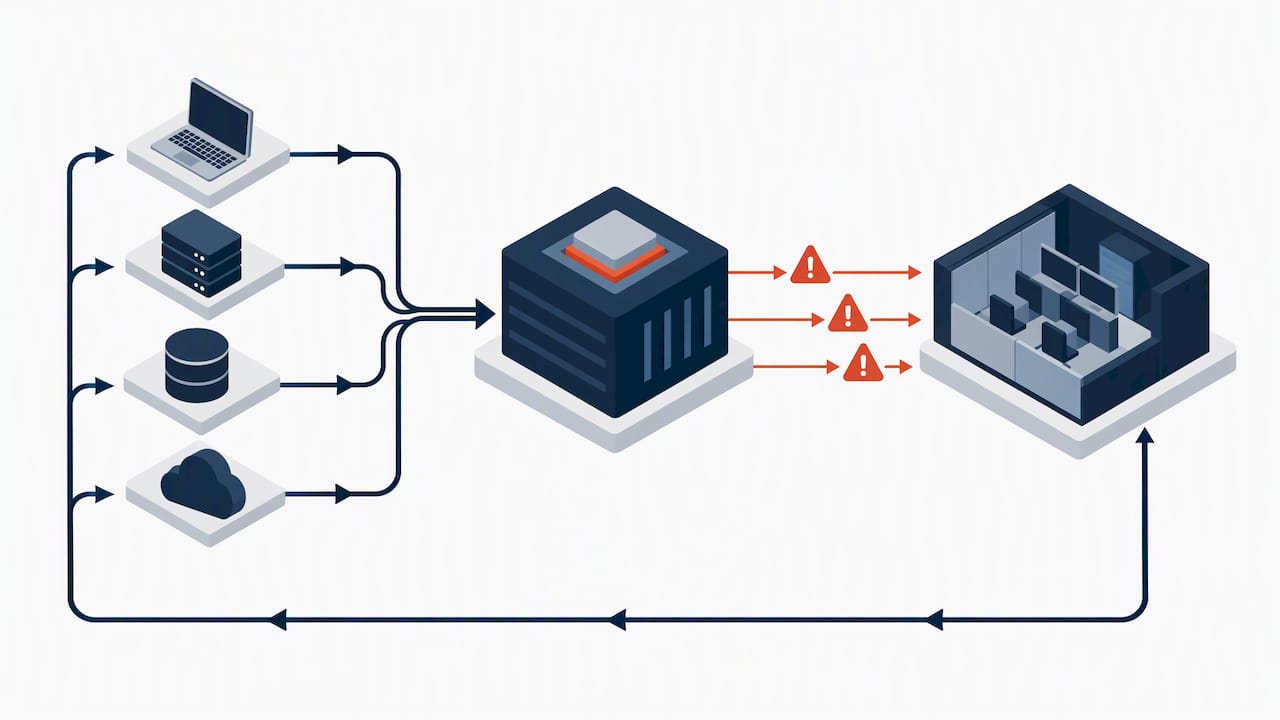
CISA’s Logging Reference Architecture outlines several integration patterns worth considering: centralized logging where everything routes into one SIEM, hybrid models where high-value telemetry centralizes while lower-priority logs stay in source systems, and selective feeds where only specific event types forward to the SIEM. The guidance is explicit that not all telemetry has to live inside the SIEM, but it must remain retrievable within a timeframe that supports investigation.
Enrichment is where integration pays off. Common pivots include:
- EDR data to confirm whether a flagged process actually executed malicious code
- Identity and access logs to trace lateral movement across accounts
- Threat intelligence feeds to match indicators against known attacker infrastructure
- SOAR playbooks to automate repetitive triage steps and speed up response
CISA’s architecture guidance frames logging design as something that must be testable against incident response objectives, not just a storage decision. That’s a meaningful shift from treating logging as a compliance checkbox toward treating it as an operational capability.
Retention strategy follows the same logic: keep frequently queried operational data in a fast, searchable store, and keep long-term forensic archives accessible through a slower but reliable retrieval process. The practical rule is simple. If your team can’t pull relevant evidence fast enough to support an active investigation, your retention architecture has failed regardless of how much data you’re storing.
When to Adopt SIEM, Managed SIEM, SOC, or MDR
Choosing among these options comes down to five variables: telemetry volume, in-house staffing, regulatory requirements, budget, and the response-time SLA you need.
- SIEM alone fits organizations with compliance logging requirements and the internal staff to review and act on alerts.
- Managed SIEM fits teams that generate meaningful telemetry but lack the headcount to tune rules and triage alerts around the clock.
- MDR or outsourced SOC fits organizations that need continuous detection and response but can’t justify building 24/7 internal staffing.
- Co-managed SOC fits mid-sized organizations that want to retain some internal visibility while offloading after-hours coverage and specialized investigation work.
Whichever path you’re evaluating, ask vendors directly about telemetry coverage (what sources they ingest), retention periods (how long data stays searchable versus archived), documented playbooks (how they handle common incident types), and escalation paths (who contacts you, how fast, and through what channel).
Phased adoption often works better than a single large commitment. Start by fixing telemetry hygiene, meaning you collect the right data from the right sources. Move to managed SIEM once that data is clean and consistent. Add co-managed or outsourced SOC coverage once you understand your actual alert volume and response gaps.
Staffing, Alert Fatigue, and Common Pitfalls
The 2026 SANS SOC Survey found that SIEM remains the top technical skill organizations hire for, yet many SOCs still struggle with staffing and management alignment that limits how effectively that skill gets used. Hiring purely to fill SIEM gaps tends to produce teams focused on keeping the platform running rather than improving detection.
A related failure mode is dumping every available log into the SIEM without a retrieval plan. The SANS/Elastic 2025 SOC Survey found that 42% of SOCs do exactly this, which inflates storage costs and buries useful signals under noise.
- Plan selective feeds and enrichment before expanding raw ingestion.
- Tune correlation rules continuously rather than treating initial configuration as final.
- Track mean time to respond, false positive rate, and telemetry coverage as core metrics.
Pro Tip: If your analysts spend more time dismissing false alerts than investigating real ones, the fix is tuning and automation, not more headcount.
How a Managed Provider Packages SIEM and SOC for Small Businesses
Small and mid-sized businesses rarely have the budget to staff a 24/7 SOC internally, which is why many managed providers bundle SIEM, endpoint detection, and round-the-clock monitoring into a single service rather than selling each piece separately.
- A bundled offering typically combines SIEM-style log correlation with EDR and continuous monitoring under one contract.
- Flat-rate pricing removes the budgeting uncertainty that comes with usage-based SIEM licensing.
- A provider with local presence tends to onboard faster since they already understand common infrastructure patterns in the area.
- Before signing, confirm incident escalation timelines, forensic data access, and reporting frequency in writing.
This is the model behind SOC Monitoring & MDR, which pairs continuous detection with the support of Endpoint Security & EDR rather than treating SIEM as a standalone purchase.
What This Means for Your Next Move
If you take one thing from this comparison, it’s that tooling without an operating model is wasted spend. I’d prioritize telemetry hygiene and logging design before buying anything new, then invest in people (internal or managed) once you know what you’re actually monitoring. Audit your current coverage, pick one or two high-value use cases, and evaluate managed options against that baseline before expanding further.
— Jim O’Connell
How Axio Networks Supports SIEM and SOC Needs for SMBs
We built our security services around the reality that most small and mid-sized businesses can’t staff a 24/7 SOC on their own, and buying SIEM software alone doesn’t solve that. Our SOC Monitoring & MDR service combines continuous monitoring with Endpoint Security & EDR, so you get detection and response coverage without assembling the pieces yourself.
- We price our services so that costs are predictable and avoid surprises related to usage or incidents.
- Our team understands the infrastructure patterns common to businesses in our service area.
- Security is built into every service we deliver, including our broader Managed IT Services, rather than sold as a separate add-on.
If you’re weighing whether to build internal SOC capability or hand monitoring to a managed partner, we’re glad to walk through what coverage would look like for your environment. Check our cybersecurity services to see where SOC monitoring fits into your broader security plan.
FAQ
What is replacing SIEM?
Nothing fully replaces SIEM, though managed detection and response (MDR) and extended detection and response (XDR) platforms are absorbing more of the day-to-day monitoring workload. SIEM remains the system of record for long-term logs and forensic investigation even as these newer tools handle more real-time detection.
What are SOC 1, SOC 2, and SOC 3 reports?
These are auditing frameworks unrelated to a Security Operations Center. They assess how a service organization handles data security, availability, and privacy controls, and are typically relevant for compliance planning rather than day-to-day threat monitoring. Organizations pursuing SOC 2 compliance often need to align their logging and monitoring practices with audit requirements, which is a separate project from running a security operations center.
Will SOC be replaced by AI?
AI tools are increasingly used to triage alerts and accelerate investigation within a SOC, but human judgment still drives containment decisions and stakeholder communication during real incidents. The more realistic trajectory is AI handling more first-pass triage while analysts focus on complex investigations and response decisions.
Is SOC Tier 1 entry-level?
Yes, Tier 1 analyst roles are generally considered entry points into SOC work, focused on monitoring alerts and performing initial triage before escalating confirmed incidents. Tier 2 and Tier 3 roles typically require more investigative experience and handle deeper analysis or complex intrusions.
Sources
- Logging Reference Architecture (LRA)
- 2026 SANS SOC Survey Insights: A Decade of Evolution in Cyber Defense
- SANS SOC Survey 2025 (summary via Elastic)
- What’s the difference between SIEM, managed SIEM and SOC? – Jisc