24/7 SOC monitoring provides continuous detection plus staffed investigation and response, so incidents are validated and mitigated the moment they appear rather than discovered hours later. Most organizations get this through a managed SOC service, an in-house team, or a hybrid of both, depending on budget and risk tolerance.
TL;DR:
- A monitoring stack needs endpoint, network, identity, cloud, and email logs flowing continuously; gaps in any source can hide an intrusion.
- A managed provider usually handles detection and initial triage, while your organization retains business decisions and approval for major incident containment.
- Before signing, get written response targets, clarify who reviews overnight alerts and approves containment, and request a redacted investigation or limited pilot.
- GDPR requires breach notification within 72 hours, so continuous detection supports timely discovery and an auditable response when personal data is involved.
Table of Contents
- What a 24/7 SOC is and how continuous monitoring works
- Core technologies and signals 24/7 SOCs rely on
- Operational models: in-house, managed SOC, hybrid, and AI augmentation
- Benefits, expected outcomes, and ROI of continuous 24/7 monitoring
- How to choose a 24/7 SOC provider: criteria and questions to ask
- Publisher perspective: how Axio Networks delivers 24/7 SOC monitoring
- Compliance and regulatory considerations specific to 24/7 SOC monitoring
- Role of threat intelligence sharing and collaboration with external entities
- Continuous improvement and tuning of SOC monitoring to reduce false positives
- User behavior analytics as a component of SOC monitoring
- Training and skill requirements for SOC analysts in a 24/7 environment
- What actually matters when you deploy this
- Get 24/7 SOC monitoring built into your managed IT
- FAQ
- Sources
What a 24/7 SOC is and how continuous monitoring works
A true 24/7 SOC is not a rotating on-call list that someone checks between other duties. It is a staffed function where analysts are actively watching telemetry, correlating alerts, and making decisions around the clock, including nights, weekends, and holidays. An on-call rota, by contrast, reacts after an alert has already waited for a human to notice it, which is exactly the gap attackers count on.
Continuous monitoring typically spans several layers of an organization’s environment at once. NIST SP 800-61r3 recommends monitoring that covers network activity, endpoints, cloud services, personnel activity, and external service provider activity, since a gap in any one of these becomes the path an intruder uses.
The event lifecycle inside a SOC generally follows a consistent pattern:
- Signals arrive from endpoints, network sensors, cloud logs, identity systems, and email filters.
- Correlation tools group related signals into a single alert instead of dozens of disconnected ones.
- An analyst reviews the alert, confirms whether it reflects real malicious activity, and assigns a verdict.
- Confirmed incidents get a ticket, a severity rating, and a handoff to containment or to the client’s own IT team.
Responsibilities are split clearly in a well-run SOC. Analysts triage and investigate, incident handlers own containment and recovery steps, and asset owners inside the client organization confirm business context, such as whether a flagged server is actually scheduled maintenance or a genuine anomaly.
Core technologies and signals 24/7 SOCs rely on
A handful of technologies make continuous monitoring possible at scale, because no team of humans can read raw logs fast enough on their own.
SIEM platforms sit at the center, pulling logs from across the environment into one place and correlating events that would look harmless in isolation but suspicious together. SOAR tools layer automation on top, enriching alerts with context and running playbooks so analysts spend time on judgment calls rather than repetitive lookups. EDR and XDR tools extend this to the endpoint level, watching process behavior and, in many cases, automatically isolating a compromised device before an analyst even finishes reading the alert. Cyber threat intelligence feeds and the MITRE ATT&CK framework give analysts a shared vocabulary for classifying what they are seeing and prioritizing which alerts deserve immediate attention.
NIST SP 800-61r3 recommends using SIEM and SOAR specifically to reduce event volume down to a human-reviewable subset, which is the practical reason these tools exist: raw log volume from a mid-sized network is far beyond what any analyst team could review manually, as NIST’s incident response guidance lays out.
For continuous monitoring to actually work, certain telemetry sources need to be streaming in consistently, not added as an afterthought:
- Endpoint telemetry from every laptop, server, and workstation, not just a sample.
- Network traffic logs from firewalls, VPN concentrators, and internal segmentation points.
- Identity and authentication logs, since credential misuse is a common entry point.
- Cloud platform logs (Microsoft 365, Google Workspace, AWS, Azure) covering admin actions and data access.
- Email security logs, given how often phishing is the first step in an incident.
Organizations evaluating endpoint coverage in more depth can review how endpoint detection and response fits into this telemetry picture, since EDR data quality directly shapes how fast a SOC can confirm and contain a threat.
Operational models: in-house, managed SOC, hybrid, and AI augmentation
Choosing a delivery model comes down to matching organizational constraints, staffing realities, and risk tolerance to the right structure.
- In-house SOC: Running this internally means staffing enough analysts to cover three shifts, seven days a week, plus overlap for handoffs and vacation coverage. Shift premiums, specialized training, and the tooling licenses (SIEM, SOAR, EDR) add up quickly, which is why most organizations below enterprise scale find true 24/7 in-house coverage difficult to sustain.
- Managed SOC (SOC-as-a-service): A managed provider supplies staffed analysts, the detection stack, and defined response procedures under a shared-responsibility model, where the provider handles detection and initial triage while the client retains ownership of business decisions and final containment approval for major incidents.
- Hybrid and follow-the-sun models: Some organizations keep daytime monitoring in-house and hand off to a managed provider overnight, or use a follow-the-sun arrangement across time zones. This works, but it requires clean handoff documentation so context is not lost between teams.
- AI and automation augmentation: Automation speeds up enrichment and can auto-contain certain endpoint threats, but it still requires human oversight for verdicts that carry business consequences, since automated systems can misclassify legitimate activity as malicious or the reverse.
Benefits, expected outcomes, and ROI of continuous 24/7 monitoring
The core financial argument for continuous monitoring is time. Every hour an intruder sits undetected inside a network is an hour they can escalate privileges, move laterally, or exfiltrate data, so reducing mean time to detect (MTTD) and mean time to contain (MTTC) directly limits how much damage a single incident can do.
Business impact shows up in a few concrete ways:
- Shorter detection windows mean fewer systems need to be rebuilt or restored after containment.
- Faster containment reduces the operational disruption of a ransomware event, since fewer systems get encrypted before response begins.
- Documented, timestamped incident handling gives auditors and regulators concrete evidence of due diligence rather than a verbal account after the fact.
Breach patterns tend to cluster around a small number of attack types year after year, according to Verizon’s breach research, which is part of why continuous coverage across network, endpoint, and identity telemetry matters more than coverage of any single layer alone.
When comparing build versus buy, the cost factors worth modeling side by side include analyst headcount and shift coverage, tooling and licensing (SIEM, SOAR, EDR/XDR), ongoing tuning and threat intelligence subscriptions, and the opportunity cost of IT staff time spent on monitoring instead of projects that move the business forward.
How to choose a 24/7 SOC provider: criteria and questions to ask
A provider’s marketing page will say “24/7 monitoring” regardless of what actually happens at 2 a.m.; be sure to evaluate their approach to platform security and data protection as part of your decision. The questions below separate real staffed coverage from a dashboard that nobody is watching overnight.
- Ask exactly what happens to an alert at night. Get a specific answer about who reviews it, how long that takes, and who has authority to sign off on a verdict without waking someone up.
- Confirm the required telemetry integrations. Your SIEM tenant, EDR agents, cloud logs, and identity systems all need to feed the provider’s monitoring stack, not just a subset.
- Pin down SLA targets in writing. Acknowledgement time, investigation time, containment time, and the exact escalation path if a critical incident is found should all have numbers attached, not general assurances.
- Clarify data handling and access control. Ask how your data is segmented from other clients in a multi-tenant environment and how long logs and investigation records are retained.
- Request operational proof, not a sales deck. Redacted sample investigations, historical SLA performance reports, and the option to start with a limited pilot scope all tell you more than a feature list.
Pro Tip: Ask any provider for their exact definition of “time to contain,” since the term means different things across vendors and only a written definition lets you compare it apples to apples.
Publisher perspective: how Axio Networks delivers 24/7 SOC monitoring
We deliver SOC Monitoring & MDR as an integrated part of our managed cybersecurity services, bundled into the same flat-rate contract structure we use across our managed IT work, so clients are not juggling separate monitoring invoices and separate IT invoices.
We strive to provide prompt response times as part of our managed service work, and because our SOC monitoring runs on the same telemetry and ticketing systems as the rest of our managed IT services, a confirmed incident does not have to wait for a handoff between separate vendors before remediation starts.
A few things worth knowing about how this works in practice:
- Pricing covers monitoring alongside the rest of a managed IT agreement, so costs stay predictable.
- The team works directly with client IT environments rather than through a layer of outsourced support.
- Security is integrated into the services delivered, not added as a separate line item after the fact.
If you want to validate fit before committing, ask us for a short pilot, a review of a sample investigation writeup, and a written SLA before signing anything.
Compliance and regulatory considerations specific to 24/7 SOC monitoring
Continuous monitoring supports several compliance frameworks directly, because most of them require evidence of ongoing oversight, not just a point-in-time assessment. PCI-DSS requires monitoring of cardholder data environments and timely response to suspicious activity, which a staffed SOC documents through tickets and timestamps. HIPAA’s security rule expects covered entities to detect and respond to security incidents involving protected health information, and a documented SOC process gives you the audit trail regulators ask for after an incident. GDPR’s 72-hour breach notification requirement depends on knowing quickly that a breach happened at all, which is only possible with detection running continuously rather than discovered during a weekly log review.
None of these frameworks mandate a specific vendor or technology, but all of them reward organizations that can show a consistent, documented process for detecting and responding to incidents. A SOC’s ticketing history, severity ratings, and response timestamps become the evidence base an auditor or regulator will ask to see, which is one reason continuous monitoring is increasingly treated as a baseline control rather than an optional upgrade.
Role of threat intelligence sharing and collaboration with external entities
No SOC operates in isolation from the broader threat landscape, and the strongest ones treat external intelligence as an input that shapes daily priorities rather than background reading. Resources like the SANS Internet Storm Center publish advisories that help analysts understand which threats are actively escalating industry-wide, so a SOC can adjust its monitoring posture before a specific threat reaches a given client’s environment.
This kind of collaboration also extends to industry sharing groups and vendor advisories, where indicators of compromise, newly observed attacker techniques, and vulnerability disclosures get shared faster than any single organization could discover them independently. A SOC that ingests this intelligence can pre-emptively tune detections for an emerging technique rather than waiting to see it firsthand. Mapping incoming intelligence against the MITRE ATT&CK framework gives analysts a common structure for deciding which new technique matters most to their specific environment, since not every emerging threat applies equally to every industry or system configuration.
Continuous improvement and tuning of SOC monitoring to reduce false positives
A SOC that never tunes its detections drifts toward one of two failure modes: analysts drowning in false positives until real alerts get missed in the noise, or detections set so conservatively that genuine threats slip through quietly. Neither is acceptable in a function whose entire value proposition is catching things fast.
Tuning is ongoing work, not a one-time setup step. Analysts review which alerts consistently turn out to be benign and adjust correlation rules, suppress known-safe patterns, and add context (like recognizing a legitimate admin’s unusual-but-authorized login pattern) so the same false positive does not resurface every week. On the other side, new detections get added as threat intelligence surfaces techniques the current ruleset does not catch yet.
This cycle matters because attacker techniques shift constantly, and a detection ruleset calibrated for last year’s threat landscape leaves real gaps today. Teams that treat tuning as a scheduled, recurring activity rather than an afterthought tend to keep both false positive rates and missed detections lower over time, which is part of why providers worth evaluating should be able to describe their tuning cadence concretely rather than in vague terms.
User behavior analytics as a component of SOC monitoring
User behavior analytics adds a layer of detection that pure signature or rule-based alerts miss entirely: the case where credentials are valid, the login looks technically normal, but the behavior itself is out of character. A finance employee suddenly accessing systems they have never touched before, or a login from a location and time pattern that breaks from someone’s established routine, is exactly the kind of signal that behavioral analytics is built to flag.
This matters because a growing share of serious incidents start with compromised credentials rather than malware, meaning traditional endpoint or network signatures have nothing unusual to catch. Behavioral baselines, built from weeks or months of normal activity for each user and system, give a SOC something to compare new activity against even when every individual action looks legitimate on its own.
Integrating this into a 24/7 monitoring program means identity and access logs need to be flowing into the same analysis pipeline as endpoint and network telemetry, since behavioral anomalies often only make sense in combination with other context, like a login happening at the same time as an unusual file access pattern. Organizations evaluating providers should ask specifically whether behavioral analytics is part of the standard monitoring stack or an added-cost feature.
Training and skill requirements for SOC analysts in a 24/7 environment
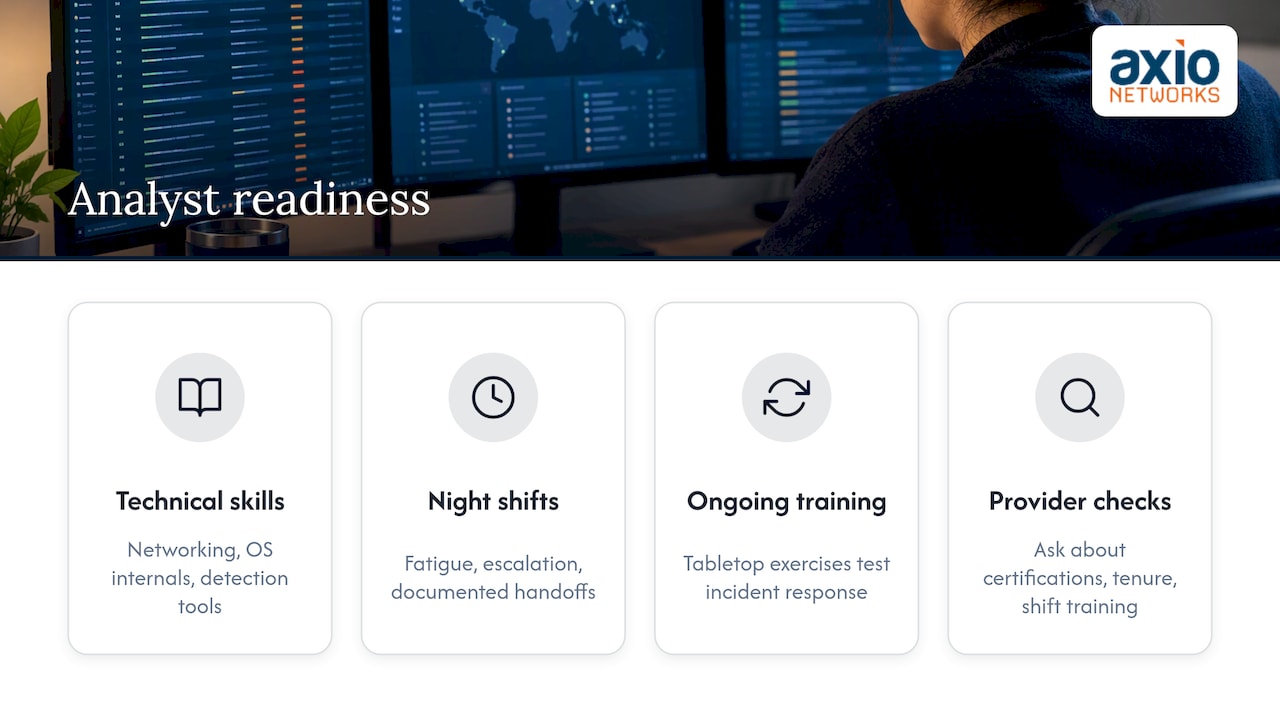
Staffing a SOC that actually runs around the clock requires more than hiring enough bodies to fill shifts. Analysts need a working grasp of networking fundamentals, operating system internals, and the specific detection tools in use, along with the judgment to tell a genuine incident apart from a false alarm under time pressure, often at 3 a.m. with incomplete information.
Overnight and weekend shifts carry their own challenges beyond technical skill. Fatigue management, clear escalation procedures for when a junior analyst needs a second opinion, and documented handoff procedures between shifts all affect whether quality holds steady across all three shifts or degrades during the hours when fewer senior staff are on duty.
Ongoing training matters as much as initial hiring, since attacker techniques and the tools used to detect them both change constantly. Analysts benefit from regular exposure to frameworks like MITRE ATT&CK for classifying new techniques, along with recurring tabletop exercises that test how the team handles a realistic incident scenario before a real one forces the issue. Buyers evaluating a provider’s team should ask about analyst certifications, average tenure, and how training is structured across shifts, since a provider that cannot describe this clearly may be relying more heavily on junior staff overnight than during the day.
What actually matters when you deploy this
Most organizations overcomplicate the decision about continuous monitoring by starting with vendor comparisons before they understand their own environment. Three things matter more than any feature checklist.
First, inventory your telemetry sources before evaluating anyone: know what’s logging and what isn’t. Second, decide your delivery model based on honest staffing capacity, not aspiration. Third, run a short pilot before signing a long contract. The most common mistake is accepting a vendor’s dashboard metrics at face value instead of asking for a redacted sample investigation. Validate claims with evidence, not marketing language.
— Jim O’Connell
Get 24/7 SOC monitoring built into your managed IT
If you have made it this far, you already understand why continuous monitoring beats an on-call checklist: threats do not wait for business hours, and neither should detection. We built SOC Monitoring & MDR directly into our flat-rate managed IT contracts, so Phoenix-area businesses get staffed overnight coverage without managing a separate vendor relationship or a separate invoice.
Start with a pilot or a short discovery conversation. We’ll walk through your current telemetry, show you what a sample investigation looks like, and confirm whether our SLAs fit your risk profile before you commit to anything.
FAQ
How does a SIEM help SOC analysts fight security threats?
A SIEM centralizes logs from across an environment and correlates related events into a single alert, which lets analysts spot patterns that would be invisible in any one log source alone. NIST’s incident response guidance specifically recommends SIEM and SOAR together to reduce raw event volume down to a set small enough for human review.
What tools do 24/7 SOCs typically rely on?
Common building blocks include a SIEM for log correlation, SOAR for automated enrichment and playbooks, EDR or XDR for endpoint detection and containment, and threat intelligence feeds mapped against frameworks like MITRE ATT&CK. The exact toolset varies by provider, but these categories cover most of what a functioning SOC stack needs.
What is cybersecurity monitoring?
Cybersecurity monitoring is the ongoing collection and analysis of security data, such as network traffic, endpoint activity, and access logs, to detect suspicious behavior as it happens rather than after the fact. Continuous monitoring, the 24/7 version of this, adds staffed review around the clock so a detected anomaly gets investigated immediately instead of waiting for the next business day.
Do I need an in-house team to get 24/7 SOC coverage?
No. Many organizations get continuous coverage through a managed SOC provider rather than building and staffing a round-the-clock team internally, which avoids the shift premiums, training costs, and recruiting difficulty that come with in-house staffing. A managed arrangement still requires clear SLAs and integration with your existing telemetry sources to work well.
What should I ask a provider before signing a SOC monitoring contract?
Ask exactly what happens to an alert overnight, who has authority to confirm a verdict, and what the written SLA targets are for acknowledgement, investigation, and containment. Request a redacted sample investigation and a clear definition of any time-to-contain metric the provider advertises, since these terms vary across vendors.
Sources
- Incident Response Recommendations and Considerations for Cybersecurity Risk Management: A CSF 2.0 Community Profile (NIST SP 800-61r3)
- MITRE ATT&CK
- SANS Internet Storm Center (Infocon)