A help desk fixes technical problems as users report them. A service desk does that too, then goes further: it handles requests, access, changes and communication, and it looks for patterns so the same problems stop coming back. The terms are often used as if they mean the same thing, and in a small company they often do. The difference matters when you decide what to buy, what to ask a provider for, and how much structure your business needs.
This guide explains each model in plain terms, compares them side by side, and shows how a small or mid-sized business can pick the right one.
TL;DR
- A help desk is the reactive, break/fix front line: password resets, software errors, hardware problems, one ticket at a time.
- A service desk is the single point of contact for everything users need from IT, including incidents, service requests, access and changes, and it works to prevent repeat issues.
- In ITIL, the framework behind the term, the service desk is a practice inside IT service management (ITSM). ITIL 4 does not define a help desk at all.
- Small teams with simple needs can run well on a help desk. Growing companies with more systems, users and compliance duties usually need service desk processes.
- You do not have to choose one by name. What counts is whether your provider handles both the fix and the follow-through.
Table of Contents
- What a help desk does
- What a service desk does
- Help desk vs. service desk at a glance
- A password lockout, handled both ways
- How ITIL and ITSM fit in
- Which model does your business need?
- Why the label matters less than the outcome
- Our perspective
- How Axio Networks handles both
- FAQ
- Sources
What a help desk does
An IT help desk is the place employees go when technology stops them from working. It might be a phone number, an email address, a chat window or a portal. Technicians log each request as a ticket, fix it or pass it to someone who can, and keep the user informed until it is resolved.
The core of the job is incident management: receiving and resolving user-reported problems, the break/fix work ITIL describes. Typical examples include:
- A locked account or forgotten password
- Email that stopped syncing on a phone
- A printer, laptop or Wi-Fi connection that is down
- A software application that crashes or will not install
According to ServiceNow’s overview of help desk functions, a help desk usually provides level 1 and level 2 support, escalates incidents up the ladder when needed, offers self-service options, and acts as a single point of contact for IT support. Most help desks also handle simple service requests, such as a new account or access to a shared folder.
The defining trait is the way the work flows. TechTarget describes the help desk as a tactical, reactive resource that gives short-term, tangible help with specific technical issues. Someone reports a problem, the desk fixes it, the ticket closes. That is a clear, valuable job, and for many small businesses it is exactly what they need on a Tuesday morning when the accounting software will not open.
One more meaning of the term
You may also see “help desk” used for customer-facing support, where a company answers questions from its own customers about its products. G2 draws that line by describing the help desk as an outward-facing function and the service desk as the internal team handling tech hardware and software issues. In IT circles today, the more common usage is the reverse of that: both terms refer to internal IT support, and the difference is scope. This article uses that IT meaning.
What a service desk does
A service desk is the single point of contact between the IT organization and its users. IBM describes it as a foundational element of ITSM that covers the full lifecycle of IT service delivery, from managing service requests to resolving service issues and planning service upgrades.
That means a service desk handles more than broken things. It also takes care of:
- Service requests: new employee setup, hardware orders, software licenses, access changes
- Incidents: the same break/fix work a help desk does
- Problem management: finding the root cause behind repeated incidents
- Change management: planning and communicating updates so they do not surprise users
- Communication: telling users about outages before they start opening tickets
The IT service management article on Wikipedia explains that the ITIL approach treats the service desk as the central day-to-day contact between providers and users, a focal point for reporting incidents and submitting service requests. It also serves as an interface for other activities, such as change requests and software licensing.
The mindset is the real difference. A help desk asks, “What is broken for this person right now?” A service desk asks that question and then, “Why does this keep happening, and what should we change so it stops?”
Help desk vs. service desk at a glance
The table below pulls together the distinctions most often drawn by IT practitioners and the sources cited in this article.
| Factor | Help desk | Service desk |
|---|---|---|
| Main purpose | Resolve user-reported problems quickly | Deliver and manage IT services end to end |
| Approach | Reactive, ticket by ticket | Reactive and proactive |
| Scope | Mostly incident management (break/fix) | Incidents, service requests, problems, changes, releases |
| Typical work | Password resets, software errors, hardware faults | Everything a help desk does, plus onboarding, access, change communication, trend analysis |
| Workflow | Simple and linear: intake, assignment, resolution, closure | Structured, with defined processes, SLAs and a service catalog |
| Focus | The individual user’s immediate issue | The business and how IT supports it |
| Tools | Ticketing with basic automation | Fuller service management tooling with workflow automation and self-service |
| Best fit | Small teams with simple, contained needs | Growing or complex organizations |
The contrasts in scope and approach come from TechTarget’s comparison, and the point that a help desk centers on a single ITIL practice while a service desk spans several comes from ManageEngine’s breakdown of ITSM practices.
A password lockout, handled both ways
A concrete example shows the gap better than definitions do.
An employee is locked out of her account on Monday morning. At a help desk, a technician verifies her identity, resets the password and closes the ticket. She is back to work in minutes. That is a good outcome.
A service desk resolves the same ticket the same way. Then it looks at the bigger picture. As Resolve.io puts it, a service desk may also examine lockout trends, improve self-service, coordinate identity policies and automate resolution. If six people in one department hit the same lockout each month, the service desk finds out why and fixes the cause, whether that is a sync problem, an expiring credential or a confusing policy.
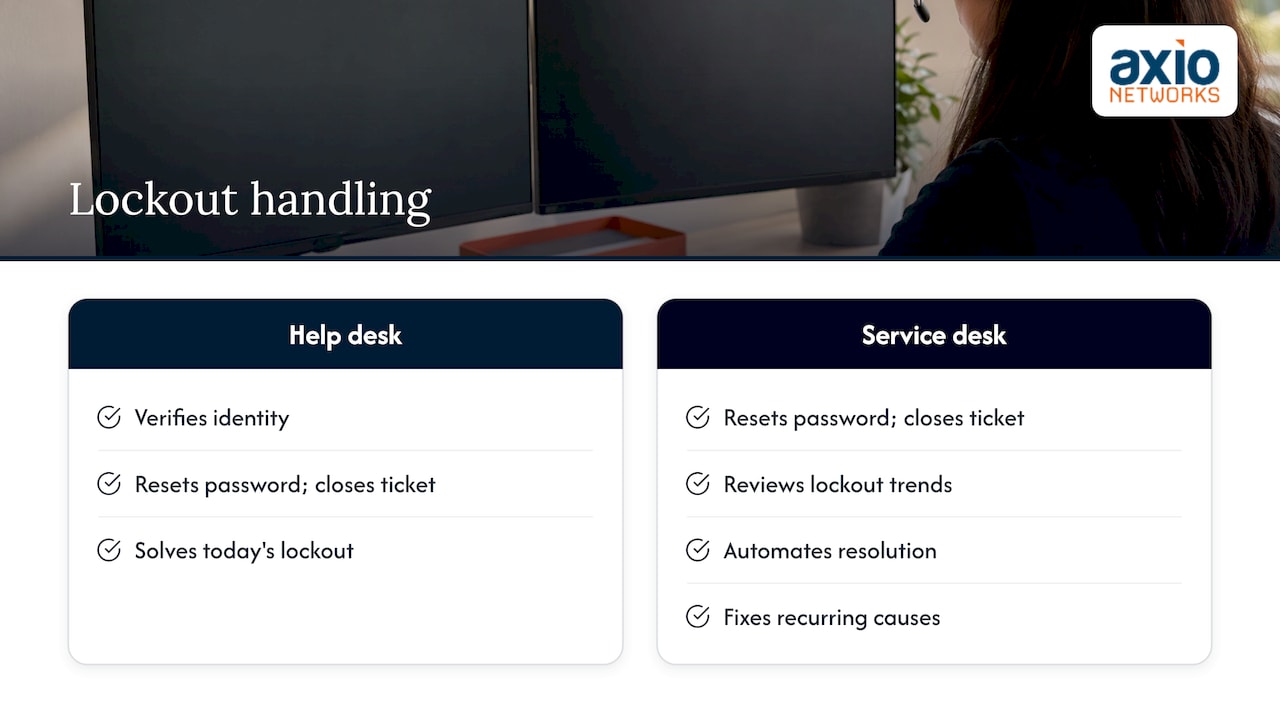
Neither response is wrong. The first solves today’s problem. The second shrinks next month’s ticket count.
How ITIL and ITSM fit in
You will see “ITIL” and “ITSM” in almost every article on this topic, so here is the short version.
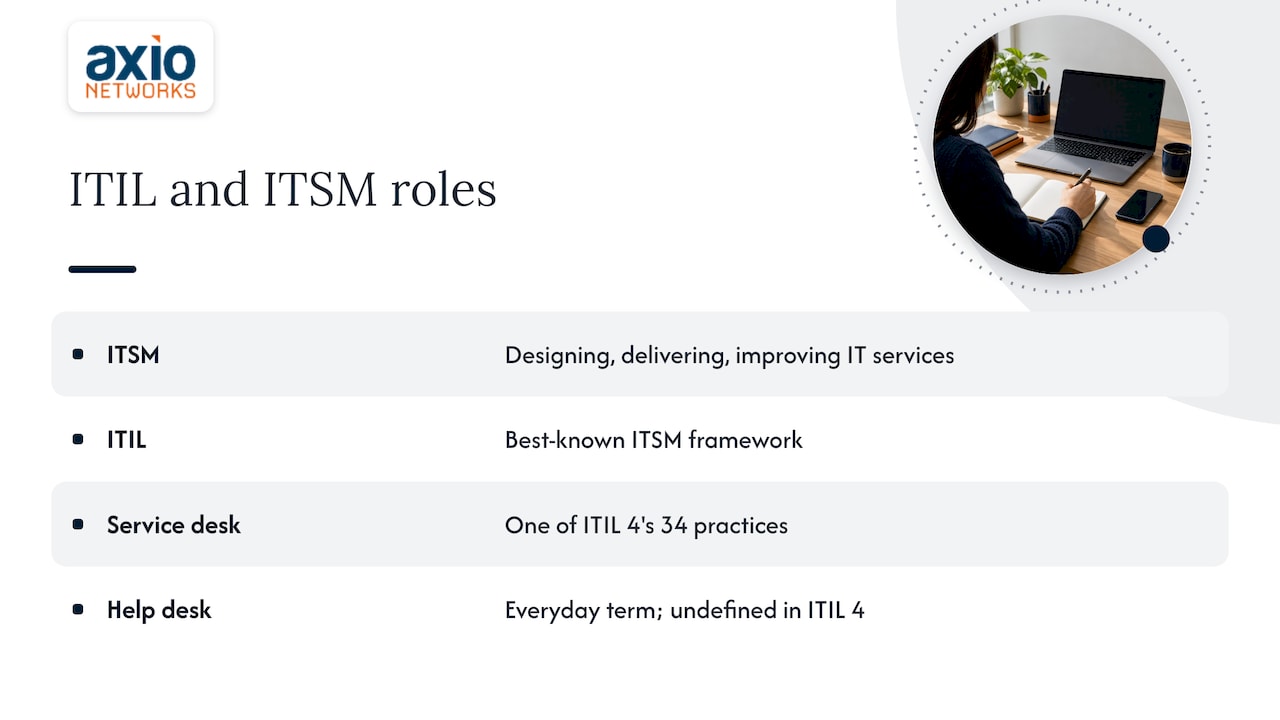
ITSM is the discipline of designing, delivering and improving IT services. ITIL is the best-known framework for doing it. Atlassian’s explanation is that the service desk is one function within ITSM, while ITSM is the whole. The help desk is older, rooted in mainframe-era IT support. The service desk grew out of ITIL’s idea of managing IT as a service.
There is one wrinkle worth knowing. Flamingo’s guide notes that ITIL 4 lists the service desk as one of its 34 practices, the entry point and single point of contact for users. It also notes that ITIL v3 called the service desk a function, and that ITIL 4 does not define a help desk. In formal ITIL language, then, the service desk is the recognized term, and “help desk” is the everyday word most people still use.
IBM goes a step further and describes the service desk as defined by ITIL as a superset of the standard help desk. In practice that means a service desk contains the help desk function. You are not giving anything up by moving to a service desk model. You are adding to it.
Which model does your business need?
There is no universal answer. Match the model to the complexity of your environment.
When a help desk is enough
TechTarget notes that small and mid-sized businesses with limited IT or support needs can often be served by a dedicated, experienced help desk for targeted support matters. A help desk fits well when:
- You have a small team, often in one location
- Your software stack is simple and mostly cloud-based
- Most requests are “something broke, please fix it”
- You do not have formal compliance obligations that demand documented processes
When you need service desk processes
Somewhere between 25 and 250 employees, many companies cross a line. You hire faster, add applications, open a second office, take on clients who ask about your security practices, or face regulations that require evidence of how you manage changes and access. At that point, ticket-by-ticket fixing leaves work undone. You need:
- A reliable process for onboarding and offboarding employees
- Defined response and resolution targets, so everyone knows what to expect
- Change planning, so updates do not interrupt the workday
- Trend reporting that shows where the recurring pain is
- A knowledge base and self-service options that cut simple tickets
As Atera’s comparison frames it, a service desk suits growing organizations that need structured workflows, SLA enforcement and coordination across departments. Fully fledged ITSM, by contrast, is aimed more at large or regulated organizations where IT is mission-critical.
A quick self-check
Answer yes or no to each:
- Do the same issues come back month after month?
- Does onboarding a new hire take multiple emails and several people?
- Do you need to show clients, insurers or auditors how you handle access and changes?
- Do users find out about outages from their own broken screens rather than from IT?
Two or more yeses suggest you have outgrown a pure break/fix help desk. If the answer is mostly no, a responsive help desk may serve you well for now.
Why the label matters less than the outcome
For most small and mid-sized businesses, the name on the door is not what you are buying. You want your people working, your data protected and your IT costs predictable. Plenty of providers use “help desk” and “service desk” interchangeably, and the real question is what happens behind the ticket.
When you evaluate a provider, ask about the work rather than the title:
- How quickly does a real person respond, and is that an average or a commitment?
- Who handles onboarding, offboarding and access requests?
- Does the provider look for root causes of repeat tickets?
- Is security part of every request, or a separate add-on?
- Is the price fixed, or do tickets, projects and after-hours calls bill separately?
Those answers tell you more than whether the provider calls its team a help desk or a service desk. For a view of how strategic service desk practices differ from tactical issue resolution, this IT strategy resource covers the business-alignment side of the same question.
Our perspective
We spend our days supporting small and mid-sized businesses across the Phoenix metro area, and we see the help desk vs. service desk debate a little differently than the software vendors do.
Our clients do not wake up wanting a service desk. They want the phone call answered, the problem fixed and the same problem never to return. So we build our support around both halves. The help desk half is speed: our average response time is under 30 minutes, because a stalled employee is a cost the business is paying every minute. The service desk half is discipline: requests, access, changes and recurring issues get handled as part of a managed service, not as one-off favors.
We also think security cannot sit in a separate lane. Many of the most common tickets, like a strange login prompt, a suspicious email or a lost laptop, are security events in disguise. Our security-first design means that every ticket is handled with that in mind, from the first call.
Pricing matters here too. A flat-rate model removes the hesitation that comes with per-ticket billing. When calling for help does not trigger a surprise invoice, employees report problems early, and early reports are cheaper to fix and safer for the company. It is also why we see the best results when support, monitoring and strategy sit under one agreement with a local team that knows the businesses and the environment here.
If you are weighing the two models, our advice is simple: pick the partner that delivers the outcomes of a service desk with the responsiveness of a good help desk.
Jim O’Connell
How Axio Networks handles both
If you want fast support and the process behind it without building an IT department, our managed IT services combine help desk support, remote and on-site help, network and server administration, Microsoft 365 management and backup and disaster recovery under a flat-rate model. Security is built into every service, from endpoint and email protection to SOC monitoring. Our IT help desk is staffed by a local team that serves businesses across the Phoenix metro area.
If you would like to talk through what your business needs, visit Axio Networks to get started.
FAQ
What is the difference between a service desk and a help desk?
A help desk is reactive and focused on resolving user-reported problems, the break/fix work known as incident management. A service desk is the single point of contact for all IT needs, including incidents, service requests, access and changes. It also works to prevent recurring issues, as described in Atlassian’s comparison.
What does an IT help desk do?
An IT help desk is a central point where employees report technical problems. Technicians log each request as a ticket, troubleshoot hardware, software and network issues, escalate complex problems and keep the user informed. Duties such as level 1 and 2 support and knowledge management are common.
Is a service desk the same as ITSM?
No. ITSM is the full discipline of designing, delivering and improving IT services, and the service desk is one part of it. The service desk is where users meet that discipline day to day, by reporting incidents and requesting services.
Do small businesses need a service desk?
Not always under that name. Small teams with simple environments are often well served by a capable help desk. As headcount, applications and compliance needs grow, service desk processes such as defined targets, change planning and root-cause work start to pay off. Many managed IT providers deliver both under one flat monthly fee.
Did ITIL replace the help desk?
In formal terms, yes. ITIL 4 treats the service desk as a practice and does not define a help desk. In everyday business use, though, people still say “help desk,” and the work it describes remains the foundation of the service desk.
Sources
- Help desk vs. service desk: What’s the difference? (TechTarget)
- Service desk vs help desk vs ITSM: What’s the difference? (Atlassian)
- What is a help desk? (ServiceNow)
- Service Desk vs Help Desk: How to Tell Them Apart (G2)
- What Is a Service Desk? (IBM)
- IT service management (Wikipedia)
- Help desk vs. Service desk: Key differences (ManageEngine)
- Service Desk vs. Help Desk: What’s the Difference (Resolve.io)
- What Is a Help Desk? Software & KPIs (Flamingo)
- IT service desk vs IT help desk vs ITSM (Atera)
- Business Technology Architects