Phoenix has grown into one of the top-tier data center markets in North America, with roughly 1,069 megawatts of inventory and a deep construction pipeline. The bigger question for most businesses is not whether capacity exists, but how fast power and interconnection can actually be delivered. This guide covers the market, the constraints, and how to evaluate a facility before you sign anything.
TL;DR:
- Trackers estimate Phoenix inventory differently, from 807 to about 1,070 megawatts, so compare available powered capacity rather than headline totals.
- West Valley campuses suit large power intensive deployments, while Chandler and Mesa offer denser carrier access; choose central sites when local office latency matters.
- Interconnection queues at APS and SRP can add months; ask providers for queue position, firm power status, and a confirmed delivery date before signing.
- For 1 to 5 megawatt deployments, pricing typically runs $150 to $210 per kilowatt monthly, while density, contract length, and ramp schedule affect final quotes.
- About 1.7 gigawatts was under construction in early 2026, but much of that capacity is not expected to deliver power for 12 to 24 months.
Table of Contents
- Market Size: How Much Data Center Capacity Does Phoenix Have?
- Who Operates Data Centers in the Phoenix Metro Area?
- Why Phoenix Works for Data Centers, and Where It Gets Harder
- What Colocation Costs in Phoenix and Where the Pipeline Stands
- Which New Data Center Projects Are Shaping the Phoenix Market?
- How Should You Evaluate a Phoenix Colocation Facility?
- A Local View on Procurement Priorities for Phoenix Businesses
- How Axio Networks Supports Phoenix Businesses Beyond Colocation
- FAQ
- Sources
Market Size: How Much Data Center Capacity Does Phoenix Have?
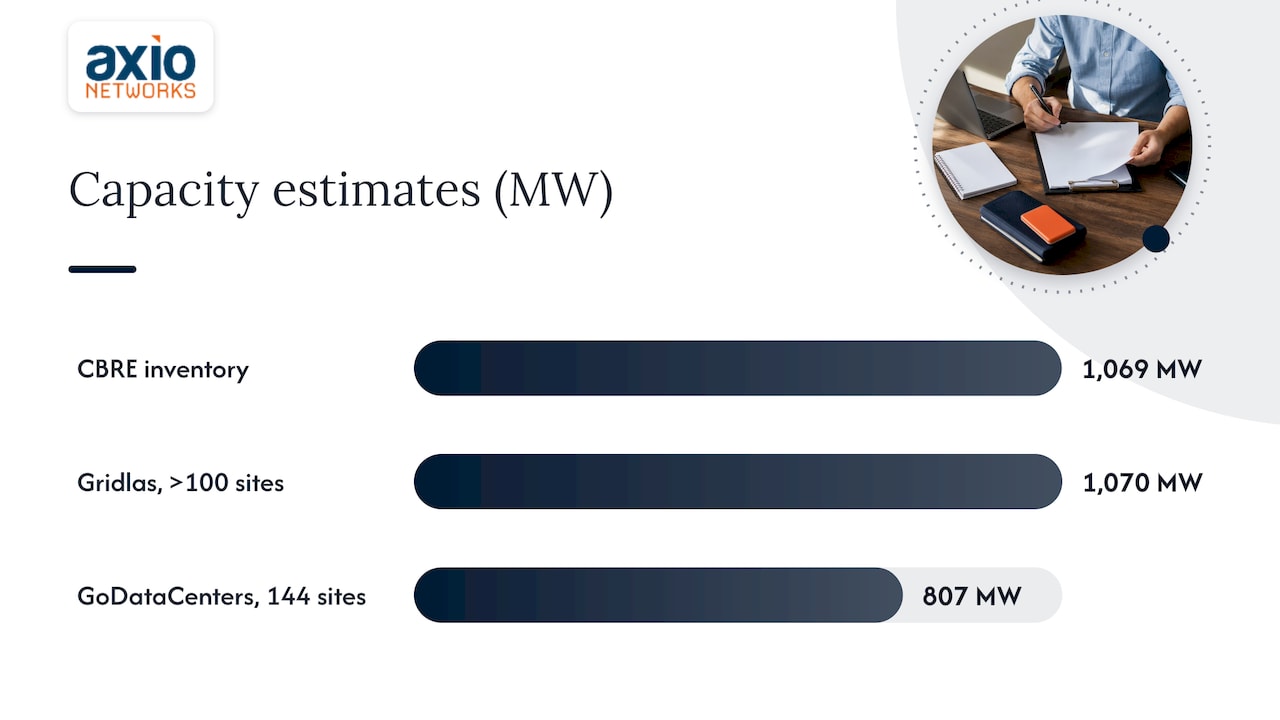
Phoenix now ranks among the largest data center markets in the country. CBRE’s Q2 2026 market report lists the metro at approximately 1,069 megawatts of inventory, while Gridlas separately tracks the Greater Phoenix area at around 1,070 megawatts spread across more than 100 facilities. GoDataCenters counts a smaller operational figure near 807 megawatts across 144 tracked facilities, a reminder that trackers define “inventory” differently and none of them should be treated as a precise count.
“Inventory” refers to built, powered capacity, whether leased or not. “Available capacity” is the smaller slice still open for new tenants, and in a tight market like Phoenix that number moves fast as hyperscale deals absorb blocks of power.
Phoenix holds roughly 1,069 megawatts of data center inventory, placing it among the top handful of U.S. markets by scale, according to CBRE.
For a business evaluating colocation, three figures matter more than the headline total:
- Total inventory, which shows market maturity and operator density.
- Available (unleased) capacity, which determines how quickly you can get space.
- Under-construction pipeline, which signals whether pricing pressure will ease or tighten.
Who Operates Data Centers in the Phoenix Metro Area?
Phoenix hosts three broad categories of providers, and where they sit in the metro affects latency, carrier access, and the kind of support you get on-site.
- Hyperscale and hub campuses concentrate in the West Valley, including Goodyear and surrounding areas, where large parcels and transmission access support multi-hundred-megawatt builds.
- National colocation operators run multi-tenant facilities in established hubs like Chandler and Mesa, often inside carrier-dense campuses with established fiber routes.
- Regional and boutique providers fill smaller footprints closer to downtown Phoenix and Scottsdale, typically serving businesses that need lower latency to local offices rather than hyperscale density.
Submarket choice shapes your options: a West Valley campus favors large, power-hungry deployments, while a Chandler or Mesa facility usually offers more carrier choice and easier access for on-site visits. If your workload needs low latency to Phoenix-based offices or retail locations, proximity trumps raw scale.
Why Phoenix Works for Data Centers, and Where It Gets Harder
Phoenix’s appeal rests on a few durable advantages: available land for large campuses, low exposure to hurricanes and seismic activity, a time zone that aligns with California for West Coast redundancy, and a history of incentive programs that lower the cost of qualifying builds.
The constraints are just as real. Gridlas points to interconnection pressure and water availability for cooling as the two binding limits on new supply, with Arizona Public Service and Salt River Project both managing queues for large power requests. Desert heat also pushes operators toward air-cooled or hybrid systems that trade water savings for higher energy draw, a balance that varies by site and design.
- Land and low disaster risk support large, long-term campus investments.
- West Coast proximity makes Phoenix a natural backup region for California workloads.
- APS and SRP interconnection queues can add months to a project timeline.
- Water-stressed cooling design choices affect both operating cost and sustainability commitments.
Pro Tip: Ask any shortlisted facility for their current interconnection queue position and whether their power is “firm” or still pending utility approval, not just “available on the roadmap.”
What Colocation Costs in Phoenix and Where the Pipeline Stands
Broker data from GoDataCenters puts typical colocation pricing for a 1 to 5 megawatt deployment in a range of roughly $150 to $210 per kilowatt per month. Treat that as a planning range, not a quote: density, contract term, and ramp schedule all move the final number.
Supply is expanding quickly. Industry trackers reported roughly 1.7 gigawatts under construction across the market in early 2026, a volume expected to influence pricing over time.
- Typical colo pricing runs about $150 to $210 per kilowatt per month for 1 to 5 MW deployments.
- Roughly 1.7 gigawatts of capacity was under construction metro-wide in H1 2026.
- The Arizona Computer Data Center Program offers a transaction privilege and use tax exemption for qualifying facilities that meet state investment thresholds, administered through the Arizona Commerce Authority.
Businesses weighing a long-term colo contract should confirm current eligibility and certification steps directly with the Arizona Commerce Authority before assuming a project qualifies.
Which New Data Center Projects Are Shaping the Phoenix Market?
Several headline projects are worth tracking because they will determine how much capacity actually reaches the market over the next few years. The Arizona Technology Council’s roundup of metro developments highlights the scale and spread of current activity.
- Large hyperscale campuses expanding in the West Valley, adding hundreds of megawatts over multiple phases.
- Multi-tenant colocation expansions in Chandler and Mesa, extending existing carrier-dense campuses.
- New powered-shell projects in Goodyear tied to utility transmission upgrades.
- Smaller regional facilities adding capacity closer to central Phoenix for latency-sensitive tenants.
These projects affect buyers differently depending on timing. Near-term availability stays limited because much of this pipeline will not deliver power for 12 to 24 months, while the medium-term effect should be more competitive pricing and broader site choice.
How Should You Evaluate a Phoenix Colocation Facility?
Picking a facility by price per kilowatt alone is a common mistake. Before you sign a contract, confirm the fundamentals that determine whether a site will actually support your workload on schedule.
- Firm power commitments, not just stated capacity on a brochure.
- Carrier ecosystem and whether the facility is truly carrier-neutral with multiple fiber providers.
- Published SLA terms, uptime guarantees, and redundancy tier (N+1 versus 2N).
- Cooling approach and water usage, especially during Phoenix summer peak loads.
- Physical security layers and compliance certifications such as SOC 2 or HIPAA alignment for regulated workloads.
- Pricing structure, including ramp terms and whether rates step up as you grow into contracted power.
- Local entitlements and realistic construction or activation timelines if you need expansion space.
During a tour, ask for the facility’s current interconnection queue status, redundancy test records, and references from tenants running comparable workloads. For general guidance on separating a reliable provider from one that looks good on paper, this overview of hosting reliability standards covers questions worth asking any infrastructure provider.
Pro Tip: A facility that cannot give you a firm power delivery date, or that quotes a price without specifying ramp terms, is usually signaling a longer timeline or hidden costs later.
A Local View on Procurement Priorities for Phoenix Businesses
For Phoenix businesses, the practical priorities come down to predictable power, fast West Coast connectivity, and a procurement timeline that will not stall out waiting on a utility queue. Smaller and midsize teams rarely have the staff to chase interconnection updates or negotiate SLA fine print on their own, which is exactly where a local managed IT partner can shorten the path from decision to working deployment.
— Jim O’Connell
How Axio Networks Supports Phoenix Businesses Beyond Colocation
Not every business needs to lease its own colocation footprint. For many companies, a flat-rate managed IT and cybersecurity partnership covers the same goals, reliable uptime, secure infrastructure, and predictable costs, without the capital commitment of a colo contract.
We support businesses that do choose colocation too, managing connectivity, hybrid operations, and day-to-day administration for workloads hosted in a Phoenix facility. Our Backup & Disaster Recovery services handle recovery orchestration so a colo outage or regional event does not become a business outage, and our SOC monitoring watches colo-hosted workloads around the clock for threats. Every service we deliver, whether it is managed IT, cloud migration, or network infrastructure, runs on the same flat-rate pricing model, so there are no surprise invoices when your environment grows. If you are weighing colocation against a fully managed approach, a local team can help map out which path fits your budget and timeline.
FAQ
How many data centers are there in Phoenix?
Trackers count the Phoenix metro differently: Gridlas reports more than 100 facilities, while GoDataCenters tracks 144 facilities with a smaller measured inventory. The range reflects differing definitions of what counts as an operational data center rather than a disagreement about market size.
How far away from a data center is considered safe?
There is no single standardized safe distance published for general data center proximity, since concerns depend on noise, traffic, and local zoning rather than a fixed regulatory threshold. Businesses evaluating a site should check local zoning rules and the facility’s own environmental disclosures rather than relying on a generic figure.
Is there a new data center in Phoenix, Arizona?
Yes, Phoenix has an active construction pipeline, including hyperscale campus expansions in the West Valley and colocation growth in Chandler and Mesa, detailed in the Arizona Technology Council’s roundup of projects to watch. Industry trackers also reported roughly 1.7 gigawatts under construction metro-wide in the first half of 2026.
What are the major data center companies in Arizona?
Arizona’s data center market includes a mix of hyperscale operators, national colocation providers, and regional facility owners spread across Phoenix, Mesa, Chandler, and Goodyear. For businesses that need managed IT, cybersecurity, or cloud support around a colo deployment rather than the colo facility itself, Axio Networks provides flat-rate managed services for Phoenix-area companies.
What incentives are available for data centers in Arizona?
Qualifying facilities can receive a transaction privilege and use tax exemption under the Arizona Computer Data Center Program, administered by the Arizona Commerce Authority. Eligibility depends on meeting specific investment thresholds and completing certification, so businesses should confirm current requirements directly with the Commerce Authority before assuming a project qualifies.
Sources
- North American Data Center Demand Continues to Outpace Supply Despite Record Construction Activity | CBRE
- Phoenix & Arizona Data Center Power Demand (2026) | Gridlas
- Phoenix data center market 2026: 807 MW inventory, pricing $150-210/kW/month for 1-5 MW, 144 facilities tracked.
- 8 Metro Phoenix data center developments to watch | Arizona Technology Council
- NOTICE OF RULE MAKING: Computer Data Center Program | Arizona Commerce Authority