Most managed IT services typically cost between low and moderate hundreds of dollars per user per month, or tens to over a hundred dollars per device per month, with the final number driven almost entirely by what the contract actually covers. Before comparing any quotes, request an itemized scope of services, documented service level agreements, and a clear breakdown of onboarding costs. Without those three documents, two providers quoting the same dollar figure can deliver wildly different levels of protection and support.
TL;DR:
- Most managed IT services range from $100 to $250 per user per month, with security features and coverage hours influencing the cost.
- Onboarding usually takes 30 to 90 days and is billed separately, covering asset inventory, security hardening, and tool setup.
- Comparing quotes requires detailed documentation of scope, SLAs, exclusions, license ownership, and service definitions like monitoring types.
- Price differences between providers often hinge on security layer depth, backup frequency, coverage hours, onsite support, and compliance requirements.
- Flat-rate pricing that includes security offers predictable costs and faster incident response, making it ideal for budget-conscious small and mid-sized businesses.
Table of Contents
- Managed IT pricing models explained
- Typical price ranges and benchmarks for managed IT
- What actually drives your managed IT bill
- How to compare managed IT quotes line by line
- Onboarding, stabilization, and one-time project fees
- Sample pricing scenarios to stress-test a quote
- How we think about managed IT pricing at Axio Networks
- What I’d prioritize if I were buying managed IT today
- Get a flat-rate quote built around your actual environment
- FAQ
- Sources
Managed IT pricing models explained
Vendors price managed IT services in a handful of recognizable ways, and knowing which model you are looking at tells you a lot about how a provider will behave once you sign.
Per-user pricing charges a flat monthly rate for every employee, covering their devices, accounts, and support tickets. This model tends to align provider incentives with yours: since the provider is paid per person rather than per ticket, there is less financial upside in letting problems drag on.
Per-device pricing charges separately for each computer, server, or mobile device under management. It can get expensive fast in device-heavy environments, and it can quietly discourage consolidation, since a provider earns less if you retire old hardware.
Per-site pricing bundles a location’s infrastructure, including network gear and shared servers, into one fee regardless of headcount. It fits businesses with fluctuating staff but stable physical footprints.
Tiered pricing groups services into bronze, silver, and gold style packages, each adding more coverage (after-hours support, advanced security, compliance reporting) at a higher price point.
Flat-rate pricing charges one predictable monthly fee covering an agreed scope, with no line-item billing for standard support.
À-la-carte pricing lets you buy individual services separately (help desk only, or backup only) rather than a bundled package.
Watch for contract language that hints at hidden metering, like “standard support hours” with unlisted overage rates. That is often where a seemingly simple model turns expensive.
Typical price ranges and benchmarks for managed IT
Benchmark numbers only mean something when you know what they include, so treat these as starting points for a conversation, not a final budget.
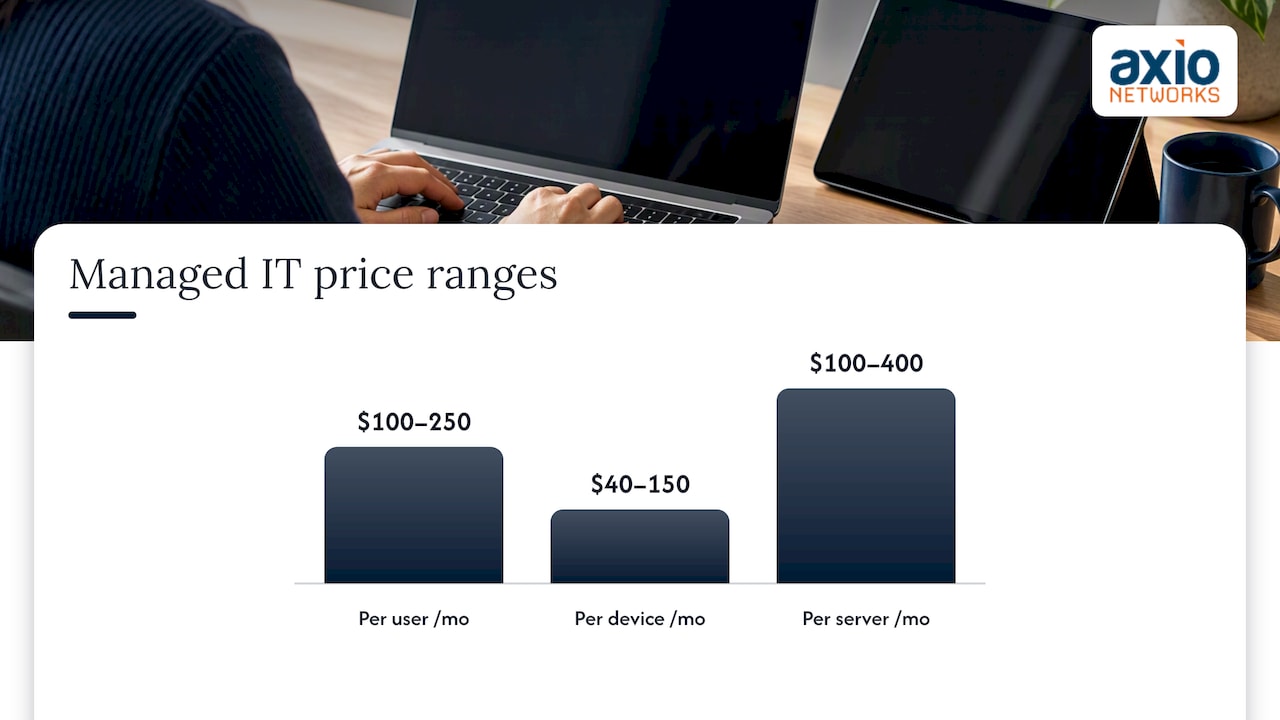
- Per-user managed IT: roughly $100 to $250 per user per month for a standard support and security bundle.
- Per-device: roughly $40 to $150 per device per month, varying by device type and criticality.
- Per-server: often $100 to $400 per server per month, higher for production servers needing constant monitoring.
For a small business, those ranges translate into rough monthly totals: a 10-person company might pay somewhere between $1,000 and $2,500 a month; a 25-person company between $2,500 and $6,250; a 50-person company between $5,000 and $12,500. These are wide bands on purpose, since the inclusion or exclusion of security monitoring, backup, and after-hours coverage swings the number substantially.
Gartner forecasts worldwide IT spending will grow 9.8% in 2026, surpassing $6 trillion for the first time, a sign that vendor offerings are growing more complex and that pricing pressure in the sector is unlikely to ease soon. When a quote lands at the low end of any benchmark range, ask specifically what is excluded rather than assuming you found a bargain.
What actually drives your managed IT bill
A handful of line items explain most of the price difference between two quotes that otherwise look similar on paper.
- Security layer depth: basic antivirus costs far less than endpoint detection and response (EDR) or managed detection and response (MDR), which add continuous threat hunting.
- Backup and disaster recovery: the frequency of backups and the speed of recovery (minutes versus hours) both affect price directly.
- Coverage hours: 24/7 monitoring and support costs meaningfully more than business-hours-only coverage.
- On-site visits: remote-only support is cheaper than contracts that guarantee technician visits.
- Compliance requirements: HIPAA, PCI, or similar obligations add documentation, auditing, and reporting work.
- Third-party licensing: software costs like Microsoft 365 are often passed through, and Gartner has flagged 2026 list-price increases tied to newly bundled Intune Suite features, which changes what a provider passes on to you.
SLA tiers compound these factors. A guaranteed 15-minute response time for critical outages costs more to staff than a same-day response commitment, because the provider needs enough technicians on call to hit that number consistently.
Pro Tip: Ask every vendor to show your licensing costs as a separate line from their service fee, so a software price increase never gets silently absorbed into an unrelated “support” charge.
How to compare managed IT quotes line by line
Comparing quotes side by side only works if you force every vendor to answer the same questions in writing.
- Request an itemized scope of services listing exactly what is included, not a one-paragraph summary.
- Ask for documented SLAs covering response time, resolution time, and escalation procedures for each severity level.
- Get a written list of exclusions: what counts as a billable project versus included support.
- Confirm who owns license costs and whether pricing is based on current software rates or will adjust with vendor increases.
- Ask whether “24/7 monitoring” means human triage or automated alerts only, since the two are priced very differently.
NIST guidance on choosing a vendor recommends defining clear security outcomes and documenting responsibility allocation before signing, since outsourcing IT never transfers your ultimate accountability for your own data. Negotiation leverage usually comes from bundling services, committing to a multi-year term in exchange for a lower rate, or insisting on a clean exit clause rather than an auto-renewing contract with steep early-termination penalties.
Onboarding, stabilization, and one-time project fees
Most providers charge a separate onboarding fee before monthly billing starts, and that is normal rather than a red flag, as long as the scope is spelled out.
- Asset inventory and documentation: cataloging every device, account, and piece of software currently in use.
- Baseline hardening: patching, password policy enforcement, and closing obvious security gaps found during discovery.
- Tool rollout: installing and configuring monitoring agents, backup software, and endpoint protection across your environment.
Stabilization typically takes 30 to 90 days depending on environment size and the state of existing documentation. You can often phase this work or negotiate a fixed-scope onboarding price instead of open-ended hourly billing, which caps your upfront risk.
Sample pricing scenarios to stress-test a quote
Running the numbers on a few realistic scenarios helps you catch an underpriced or overpriced quote before you sign anything.
- A 10-user company at $150 per user per month pays $1,500 monthly, or $18,000 annually, plus a one-time onboarding fee commonly in the low thousands.
- A 25-user company at $175 per user per month pays $4,375 monthly, or $52,500 annually, before adding premium SLA or MDR coverage.
- A 50-user company at $200 per user per month pays $10,000 monthly, or $120,000 annually, a figure that can rise 15 to 30% once MDR, enhanced backup, and compliance reporting are layered in.
A useful sanity check: compare that annual MSP total against the fully loaded cost of one internal IT hire, including salary, benefits, and overhead, a comparison explored in more depth in this TCO and in-house versus outsourced breakdown. Gartner’s Hype Cycle for managed IT services tracks which emerging capabilities, like AI-assisted monitoring, are mature enough to justify a premium in vendor pricing, which is worth checking before paying extra for a feature still early in its adoption curve.
How we think about managed IT pricing at Axio Networks
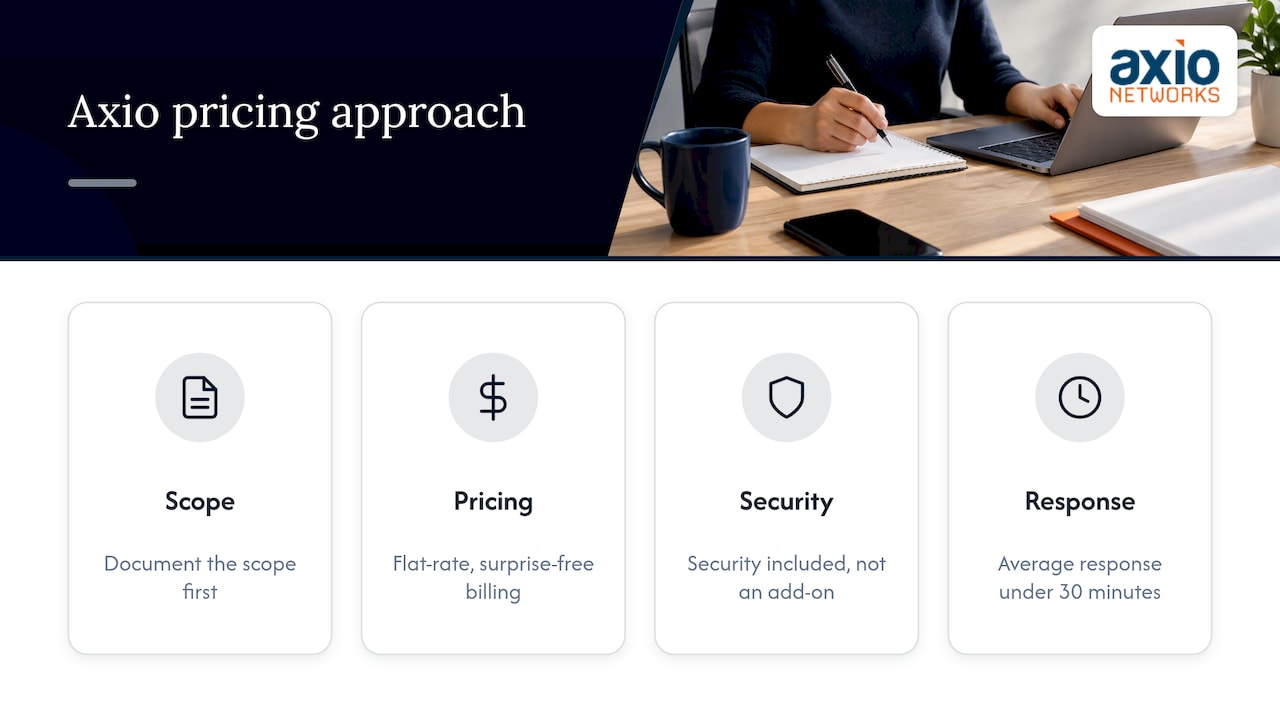
Jim O’Connell has spent years helping small and mid-sized businesses translate vague MSP quotes into real budget numbers, and that experience shapes every recommendation here: document the scope first, then negotiate price.
At Axio Networks, we built our managed IT services around a flat-rate model specifically because itemized, surprise-free billing is what budget-conscious owners ask for most often. We design security into every service rather than selling it as an add-on, and our average response time runs under 30 minutes.
Predictable pricing and integrated security solve two different buyer problems at once: budget certainty and faster incident recovery.
What I’d prioritize if I were buying managed IT today
If you take one thing from this guide, prioritize documented scope and SLAs over the lowest sticker price. A cheap quote with vague commitments almost always costs more once something breaks.
Before your next vendor call, confirm three things: itemized services with no vague bundles, a written SLA with specific response times, and a clear answer on who owns license cost increases.
— Jim O’Connell
Get a flat-rate quote built around your actual environment
We price managed IT services at Axio Networks as one flat monthly rate that already includes security, so you are not negotiating add-ons every time a new threat shows up.
Our local team in the Phoenix metro area builds every contract around a documented scope and SLA from day one, which means you know what you are paying for before you sign anything. If you want a line-item quote or a quick call with one of our vCIO consultants, request an itemized quote through our managed IT page and we will walk through your environment together.
FAQ
What is the average cost of managed IT services per user?
Most managed IT providers charge between $100 and $250 per user per month, depending on included security features, coverage hours, and compliance needs. Device-heavy or compliance-driven businesses tend to land toward the higher end of that range.
How long does managed IT onboarding usually take?
Onboarding and stabilization typically take 30 to 90 days, covering asset inventory, baseline security hardening, and tool configuration. Providers usually charge this as a separate one-time fee rather than folding it into the monthly rate.
What should I ask for before signing a managed IT contract?
Request an itemized scope of services, a written SLA with specific response and resolution times, and a clear statement of what is excluded or billed separately. NIST vendor-selection guidance recommends documenting these outcomes and responsibilities before any contract is finalized.
Does Axio Networks use flat-rate pricing?
Yes, Axio Networks prices managed IT services on a flat-rate model that bundles security into the monthly fee rather than billing it as a separate add-on. Specific pricing is available by request based on your environment.
Is per-user or per-device pricing better for a small business?
Per-user pricing often suits businesses where employees use multiple devices, since it avoids charging separately for each one. Per-device pricing can fit organizations with shared workstations or a stable, low device count per employee.
Sources
- NIST: Choosing a vendor/service provider
- Gartner forecasts worldwide IT spending to grow 9.8% in 2026