Outsourced IT support gives small and mid-sized firms predictable technology coverage, access to specialized security skills, and a monthly IT cost that does not swing with every outage or breach. It fits companies without a mature internal IT function, or any business that needs monitoring around the clock. The sections below break down pricing, service models, and how to vet a provider without getting burned.
TL;DR:
- Outsourced IT support is ideal for small to mid-sized companies lacking internal security expertise or needing 24/7 monitoring, especially in regulated industries.
- Fully managed services suit organizations with no internal IT team, while co-managed, project-based, and break-fix models accommodate varying internal capabilities and specific initiatives.
- Costs typically range from flat per-user or per-device fees to hourly rates, with higher prices driven by security features, compliance requirements, and extended coverage hours.
- Supply-chain risks are significant, and contracts must specify breach response times, audit rights, access controls, and logging to mitigate potential compromises of MSP systems.
- Choosing the right provider involves verifying documented security practices, testing backups, reviewing audit reports, and ensuring clear control boundaries before full commitment.
Table of Contents
- What outsourced IT support is and who it serves
- Service models compared: fully managed, co-managed, project-based, and break-fix
- Services you can outsource: help desk, network, cloud, security, and backup
- How much outsourced IT support costs and what drives price
- Security and risk considerations when outsourcing IT
- How to evaluate and choose an outsourced IT provider
- When you should outsource versus keep IT in-house
- Case studies and examples of outsourced IT support done well
- Publisher perspective: why security has to be built in, not bolted on
- How Axio Networks can help you get outsourced IT right
- Sources
- FAQ
What outsourced IT support is and who it serves
Outsourced IT support is a contractual arrangement in which a managed service provider (MSP) delivers, monitors, and maintains a company’s technology under a service level agreement (SLA). Instead of hiring a full internal team, a business pays a third party to handle help desk tickets, network administration, backups, and often cybersecurity, with response times and coverage hours spelled out in the contract. The Cybersecurity and Infrastructure Security Agency (CISA) defines MSPs as suppliers that deliver and manage IT services for customers under this kind of contractual relationship, which is the baseline definition most procurement teams work from.
Businesses choose to outsource for a handful of recurring reasons. Cost control tops the list: a flat monthly fee replaces the unpredictable expense of salaries, benefits, training, and emergency contractor rates. Skills access matters just as much. A five-person internal IT team rarely has deep bench strength in cloud architecture, endpoint detection, and compliance frameworks at the same time, while an MSP spreads those specialists across many clients. Compliance support and 24/7 monitoring round out the list, particularly for firms in health care, legal, or financial services where a missed alert at 2 a.m. can mean a regulatory problem by morning.
The profile that benefits most is a company with 10 to 250 employees, no dedicated security staff, and a growing dependence on cloud applications, remote work, or sensitive client data. A law firm handling privileged documents or an accounting practice managing client financial records both fit this pattern well, since they carry compliance exposure without the budget for a full security operations team.
Companies that usually keep IT in-house are those with unique, deeply customized systems, a large existing IT staff, or regulatory mandates that require direct operational control over infrastructure. For most other organizations, the question is not whether to get outside help, but which delivery model fits.
Service models compared: fully managed, co-managed, project-based, and break-fix
Outsourced IT is not a single product. Providers typically offer a mix of models, and the right choice depends on how much internal capacity a company already has.
Fully managed service covers the entire IT function: help desk, network administration, security monitoring, vendor management, and strategic planning, usually for one flat monthly rate. It suits companies with no internal IT staff at all. The main trade-off is less direct day-to-day control, since the provider owns most operational decisions within agreed policies.
Co-managed IT splits responsibilities between an internal team and the outside provider. A company might keep a single IT generalist on staff to handle daily user requests while the MSP covers security monitoring, backup verification, and after-hours coverage. This model works well for organizations that already have some IT capability but lack specialized security or infrastructure skills.
Project-based engagements cover a defined scope, such as a cloud migration, network build-out, or compliance assessment, with a start and end date rather than an ongoing contract. Break-fix is the oldest model: a provider is called only when something breaks, billed hourly, with no proactive monitoring included.
- Fully managed suits companies with no internal IT staff and continuous support needs.
- Co-managed suits companies with some internal capacity that need specialized skills or after-hours coverage.
- Project-based suits one-time initiatives like migrations or audits.
- Break-fix suits very small operations with minimal technology dependence and a high tolerance for downtime.
The shared responsibility model affects every one of these arrangements. Even under a fully managed contract, the customer retains responsibility for decisions like who gets administrative access, what data gets backed up, and which compliance obligations apply. Good contracts spell this division out line by line rather than leaving it implied.
Services you can outsource: help desk, network, cloud, security, and backup
Most MSP contracts bundle a recognizable set of services, though the exact mix varies by provider and plan.
- Help desk and endpoint support handles day-to-day user issues, password resets, software installs, and device troubleshooting.
- Network and infrastructure management covers routers, switches, firewalls, and servers, whether on-premises or cloud-hosted.
- Managed security includes endpoint detection and response (EDR), managed detection and response or SOC monitoring, and email security to filter phishing and malware.
- Backup, disaster recovery, and business continuity planning protects against data loss from ransomware, hardware failure, or natural disaster.
- Cloud migration and managed cloud services, along with Microsoft 365 administration, cover the shift from on-premises servers to hosted platforms.
A company evaluating providers should map its own gaps against this list rather than buying a generic bundle. A firm that already has strong backup practices but weak endpoint protection needs a different package than one starting from zero. Some providers offer these as separate line items; others fold them into a single managed plan. Either way, the specifics matter more than the marketing label attached to the package, since “comprehensive security” means different things depending on whether it includes 24/7 monitoring or just antivirus software.
How much outsourced IT support costs and what drives price
Pricing for outsourced IT support in the United States generally clusters into a few common structures, and the range within each is wide enough that vague quotes are a warning sign rather than a feature.
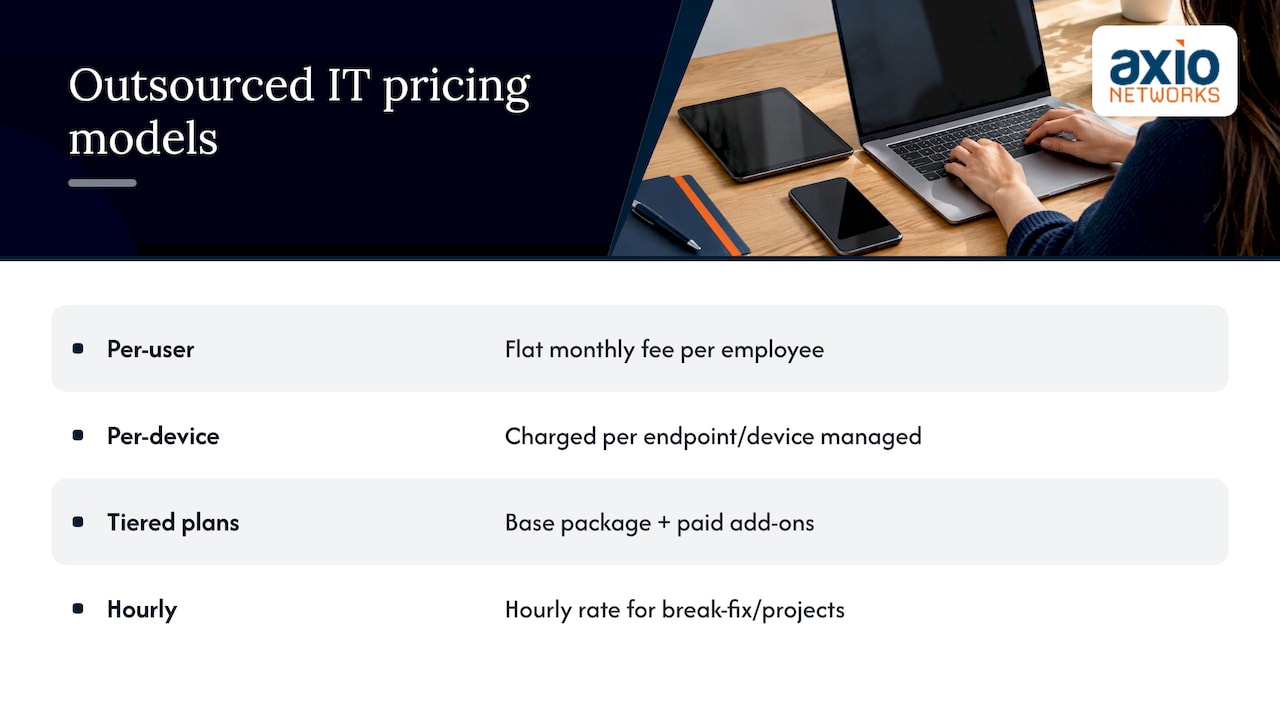
Per-user, per-month flat-rate pricing is the most common structure for ongoing managed services, bundling help desk, monitoring, and basic security into one predictable fee. Per-device pricing charges based on the number of endpoints, servers, and network equipment under management, which can work better for organizations with more hardware than staff. Tiered service plans offer a base package with add-ons for security, compliance, or extended hours. Hourly billing remains common for break-fix work and one-off projects.
Statistic: Industry pricing observed across the broader IT outsourcing market reflects a large and expanding category of spending, underscoring how many businesses now treat outsourced IT as a standard line item rather than a stopgap.
What pushes a quote toward the higher end of any range: 24/7 monitoring instead of business-hours-only coverage, advanced security add-ons like SOC monitoring or managed detection and response, a higher device count per employee, onboarding and migration fees for the first month, and compliance requirements tied to frameworks like HIPAA that demand additional documentation and audit support. HIPAA compliance enforcement guidance from the Department of Health and Human Services illustrates why regulated organizations typically pay more: the vendor has to build in reporting and access controls that unregulated businesses do not need.
A worked example helps ground this. Say a 25-employee professional services firm wants fully managed IT with help desk, network monitoring, basic endpoint security, and nightly backups, but without an in-house SOC team or compliance overlay. At a representative flat rate, the monthly bill for that scope would land somewhere in the range typical of mid-market managed plans that bundle monitoring and help desk together, before any compliance or advanced security add-ons are layered on. Adding managed detection and response or after-hours incident response support moves the number up from there. The exact figure depends entirely on the provider’s scope definition, which is why asking for a line-item breakdown matters more than comparing single lump-sum quotes.
Security and risk considerations when outsourcing IT
MSPs are attractive targets for attackers precisely because a single compromise can expose dozens or hundreds of downstream customers at once. CISA has warned specifically about this dynamic, noting that threat actors who breach an MSP’s systems can pivot into every client network the provider touches, which is why supply-chain risk deserves attention during vendor selection, not just after a contract is signed.

CISA’s National Risk Management Center has published guidance for MSP customers making clear that outsourcing does not eliminate a customer’s own risk. The guidance recommends a shared responsibility model in which the contract explicitly states who owns which security controls, rather than assuming the provider handles everything by default.
Contracts should require specific protections rather than general assurances:
- Breach notification timelines measured in hours, not vague “prompt” language.
- Right-to-audit clauses that let the customer or a third party review the provider’s controls.
- Detailed logging of administrative access to customer systems.
- Documented access controls showing who at the MSP can reach what data.
Operational mitigations matter alongside contract language. The Stop Ransomware Guide from CISA recommends limiting provider privileges to only what a task requires, maintaining separate logging streams so a compromised provider account cannot erase its own tracks, and verifying backups regularly rather than assuming they work.
Pro Tip: Ask any prospective provider for a copy of their own SOC 2 report or equivalent third-party audit before signing anything, not after.
How to evaluate and choose an outsourced IT provider
Choosing a provider is where most of the risk in outsourcing gets decided, long before any contract is signed. A structured evaluation process catches problems that a sales pitch will not surface.
Start with a core checklist covering the essentials: coverage hours, documented security posture, a written incident response plan, guaranteed response time commitments, relevant certifications, and whether the provider carries cyber insurance. A provider that cannot produce documentation for any of these should be treated as a red flag rather than a minor gap.
- Confirm access and control boundaries. Ask exactly what administrative access the provider needs and whether it can be scoped or time-limited.
- Request backup and recovery evidence. Ask for a recent test restore log, not just a statement that backups run nightly.
- Ask about breach history. A provider with no incidents in years across a large client base is either very good or has not been tested; ask how they would know.
- Request a SOC 2 or equivalent report. Independent audits carry more weight than self-reported security claims.
- Clarify the staffing model. Find out whether support comes from a dedicated team or a shared, rotating pool, since this affects both response time and institutional knowledge of a client’s environment.
Red flags worth walking away from include a refusal to put response times in writing, opaque subcontracting where the provider outsources parts of the work to unnamed third parties, and no audit rights in the proposed contract. CompTIA’s research on managed services trends notes that the industry is moving toward standardized oversight, with customers increasingly demanding contractual verification of security controls rather than accepting marketing claims at face value.
A sound procurement sequence runs through four steps: build a shortlist of three to five providers based on the checklist above, run a small pilot project or limited-scope engagement before committing to a full contract, review performance metrics like ticket resolution time and uptime after 60 to 90 days, then move to a phased full contract once the pilot proves out.
Pro Tip: Treat the first 90 days as a trial period even if the contract is annual. Most agreements include an early termination clause for exactly this reason.
When you should outsource versus keep IT in-house
The decision rarely comes down to cost alone. A handful of situational signals point clearly in one direction or the other.
Outsourcing tends to make sense when a company is growing faster than its hiring can keep pace, when IT staff is limited to one or two generalists stretched thin, when the business needs 24/7 monitoring it cannot staff internally, or when compliance gaps have surfaced during an audit or client requirement.
- Rapid growth outpacing internal hiring favors outsourcing for immediate capacity.
- Unique intellectual property requiring tight internal control favors keeping development in-house.
- Heavy regulation demanding direct operational oversight sometimes favors an internal core team with outsourced specialist support.
- A mature internal team with strong security skills may only need outsourcing for overflow or specialized projects.
Co-managed arrangements are often the right compromise when a company has some internal capability worth keeping but needs specialized skills, particularly in security, that would be expensive to hire directly.
A low-friction transition follows a simple checklist: document existing systems and passwords for knowledge transfer, run a pilot on a limited scope before full cutover, shadow the incoming provider’s team for the first few weeks, and put responsibilities in writing so nothing falls into a gap between internal staff and the new partner. CompTIA research on IT industry trends suggests a phased approach, starting with monitoring and help desk, then layering in managed security and strategic IT planning as the relationship matures, tends to produce a smoother transition than an all-at-once handoff.
Case studies and examples of outsourced IT support done well
The pattern behind most successful outsourcing arrangements is not dramatic. A professional services firm with a single overworked IT generalist typically moves first to co-managed support, handing off after-hours monitoring and backup verification while keeping day-to-day help desk internal. Within a few months, the internal hire shifts toward higher-value project work instead of firefighting, and the provider absorbs the repetitive ticket volume.
A healthcare or legal practice facing a compliance audit follows a different path. The provider’s first engagement is usually a risk and vulnerability assessment, which surfaces gaps in access controls or unpatched systems that the practice did not know existed. Remediation follows, then ongoing managed security closes the loop.
A growing company opening a second office often triggers outsourcing through a network infrastructure project: structured cabling, wireless deployment, and firewall configuration for the new location, handled as a fixed-scope project before rolling into an ongoing managed contract. In each case, the common thread is a phased start rather than a single sweeping handoff, which matches the CISA guidance on defining shared responsibility before expanding scope.
Publisher perspective: why security has to be built in, not bolted on
Most outsourced IT pitches lead with cost savings and treat security as an add-on module sold later. That ordering is backward. A provider that treats security as optional from the start will always be playing catch-up when a client’s risk profile changes, and clients rarely notice the gap until something goes wrong.
This provider emphasizes building security into every managed and project service from the start, rather than adding it only after a breach occurs, and supports this approach with a dedicated local team. Flat-rate pricing helps avoid underscoping security to lower the cost.
— Jim O’Connell
How Axio Networks can help you get outsourced IT right
If the sections above left you with a clearer sense of what you need, mapping that to a real provider is the next step. Axio Networks offers fully managed IT services with flat-rate pricing that removes the guesswork from monthly budgeting, alongside dedicated cybersecurity services including SOC monitoring and endpoint protection built into the same contract rather than sold as a separate afterthought.
A short list of where Axio Networks fits common needs:
- Companies with no internal IT staff can start with a fully managed plan covering help desk, network administration, and monitoring.
- Companies with some internal capacity but weak security coverage can add SOC monitoring and endpoint detection without replacing existing staff.
- Companies planning a cloud move can pair migration with ongoing cloud services management instead of hiring a one-off contractor.
- Companies needing strategic input without a full-time hire can bring in vCIO services alongside day-to-day support.
A typical first step is a network and security assessment, which identifies gaps before any commitment to a full contract, similar to the pilot approach described earlier in this article. From there, most engagements move into a phased managed IT agreement rather than an all-at-once switch. If you want a clearer picture of what a security-first managed plan would look like for your business, reach out through the managed IT services page to get a quote scoped to your current setup.
FAQ
What are outsourced IT services?
Outsourced IT services are technology support and management functions, such as help desk, network administration, backups, and security monitoring, delivered by a third-party provider under a contract rather than by internal staff. The arrangement is typically governed by a service level agreement that spells out coverage hours and response expectations, as CISA’s definition of MSPs makes clear.
How much does it cost to outsource IT support?
Pricing generally follows a per-user, per-device, tiered, or hourly structure, with the exact figure driven by coverage hours, security add-ons, and compliance needs rather than a single standard rate. A full-service plan with monitoring and help desk for a small business costs more than a bare-bones break-fix arrangement, and getting a scoped quote from a provider is more reliable than comparing marketing price ranges.
Is outsourcing illegal in the United States?
No, outsourcing IT support is a legal and common business practice in the United States. Regulated industries like health care must still meet their own compliance obligations regardless of who performs the work, which is why HIPAA enforcement guidance applies to the organization, not just its vendor.
Is outsourcing a dying concept?
No, outsourced IT support continues to grow rather than decline, reflected in the expanding global market tracked by Statista’s IT outsourcing outlook. Rising security complexity and skills shortages are pushing more small and mid-sized businesses toward managed providers rather than away from them.