A vulnerability assessment finds and inventories known weaknesses across systems; a penetration test attempts to exploit the most important ones to prove real-world impact. The two are complementary rather than interchangeable: scans map the surface, and pen tests confirm what an attacker could actually do with it. The rest of this guide breaks down scope, cost, outputs, and the decision rules that tell you when you need one, the other, or both.
TL;DR:
- Run vulnerability scans continuously or quarterly, then manually triage false positives against exposure; an isolated system poses less risk than an internet facing server.
- Schedule penetration tests annually or after major changes, releases, or mergers, and prioritize high value assets; organizations handling card data should follow PCI guidance.
- Use scan results to target penetration tests at clusters of high risk findings, since testing can reveal attack chains that CVSS scores alone miss.
- Require a defined scope, reproducible proof of concept, remediation guidance, and retesting; confirm whether follow up verification is included or billed separately.
Table of Contents
- What Is a Vulnerability Assessment?
- What Is a Penetration Test?
- Scope, Methods, Outputs, and Cost Side by Side
- When to Use Each, and When to Combine Them
- How to Choose a Provider or Plan an Engagement
- Turning Reports Into Fixed Risk
- Why We Recommend Continuous Scanning Paired With Targeted Testing
- Where Businesses Get This Wrong
- How We Can Help You Build a Working Program
- FAQ
- Sources
What Is a Vulnerability Assessment?
A vulnerability assessment (VA) is a broad, automated check of networks, hosts, applications, and cloud configurations against known flaws. The goal is breadth: find as many weaknesses as possible, then rank them so remediation teams know what to fix first.
Most VAs rely on scanning tools that compare installed software, open ports, and configurations against vulnerability databases, producing a prioritized list rather than proof of exploitability. Severity is typically expressed using CVSS scores pulled from the NVD CVSS calculator, which gives teams a common language for urgency.
Common VA types include:
- Network scans, which check firewalls, routers, and exposed services for misconfigurations.
- Host and endpoint scans, which look at patch levels and local vulnerabilities on servers and workstations.
- Application and API scans, which test web and API endpoints for common flaws.
- Cloud configuration reviews, which check storage, identity, and access settings against best practice.
Organizations often run VAs continuously or quarterly because they’re fast and low-cost compared to manual testing. NIST SP 800-115 notes that scanning techniques work best alongside document and log review, since automated tools generate false positives that need human triage before they turn into a remediation list.
Pro Tip: Don’t act on a raw scan report. Triage findings against your actual environment first, since a flagged vulnerability on an isolated system carries far less risk than the same flaw on an internet-facing server.
What Is a Penetration Test?
A penetration test (pen test) is a manual, goal-driven attempt to exploit vulnerabilities and prove what an attacker could accomplish once inside your environment. Where a scan tells you a door might be unlocked, a pen test tries the handle, walks through, and documents how far it got.
Pen tests generally follow a structured sequence:
- Planning and scoping, where the tester and client agree on targets, rules of engagement, and boundaries.
- Reconnaissance, gathering information about the target environment.
- Exploitation, actively attempting to breach systems using the vulnerabilities found.
- Post-exploitation, assessing how far access could be escalated or data exfiltrated.
- Reporting and cleanup, documenting findings and removing any test artifacts.
This lifecycle mirrors the testing phases described in NIST SP 800-115, which also notes that penetration testing can be intrusive and carries a real risk of operational impact if not carefully scoped.
Tests vary by how much information the tester starts with (black box, gray box, white box) and by scope, sometimes extending into social engineering or physical security checks. Because this work takes skilled humans rather than automated scripts, it costs more and takes longer than a scan, but it confirms something a scan cannot: whether a chain of smaller flaws adds up to a real breach path.
Pro Tip: Ask any tester how they handle scope creep. A well-run engagement pauses and re-confirms authorization before testing anything outside the agreed boundaries.
Scope, Methods, Outputs, and Cost Side by Side
The practical differences come down to how wide each service looks versus how deep it digs.
- Scope: vulnerability assessments cover broad swaths of infrastructure; penetration tests focus narrowly on the systems that matter most.
- Methods: assessments rely on automated scanning tools; pen tests depend on manual exploitation and tester creativity, a distinction Fortinet lays out clearly when comparing the two.
- Outputs: a VA produces a scored inventory of known weaknesses, while a pen test produces validated exploit paths and a narrative of actual impact.
- Cost and resourcing: scans are inexpensive and repeatable; pen tests require skilled testers and cost more per engagement, per Fortinet’s comparison.
- Frequency: scans often run continuously or quarterly, while pen tests are typically annual or triggered by major changes, a cadence PCI’s penetration testing guidance recommends for compliance programs.
CVSS scores from the NVD drive how VA findings get ranked, but a pen test reprioritizes based on what was actually exploitable, which sometimes elevates a moderate-scored flaw that turned out to be the key to a larger attack chain.
When to Use Each, and When to Combine Them
Matching the service to the situation keeps budgets reasonable and coverage useful.
- Routine posture checks: run vulnerability assessments on a regular cycle, informed by your patch schedule.
- Compliance cadence: follow the scanning and testing frequency outlined in PCI’s guidance if you handle card data or similar regulated information.
- Major changes or high-value assets: schedule a penetration test after a new release, a merger, or when protecting systems that would cause serious damage if breached.
- Suspected compromise or breach simulation: use a pen test to validate whether a known weakness is actually exploitable in your environment.
TechTarget’s comparison of pen testing and vulnerability scanning notes that penetration testing is often scheduled after a vulnerability assessment identifies clusters of high-risk findings that merit deeper validation, which is the combined workflow most small and mid-sized organizations should aim for: continuous scanning feeds targeted testing, and testing confirms which scan findings actually matter.
How to Choose a Provider or Plan an Engagement
Before signing a statement of work, confirm the basics that separate a useful engagement from a wasted budget line.
- Defined scope and rules of engagement: know exactly which systems are in play and what methods are off-limits.
- Tester qualifications and insurance: ask about certifications and liability coverage before testing begins.
- Evidence and reproducible proof-of-concept: findings should include enough detail that your team can verify and fix them.
- Retest options: confirm whether a follow-up verification test is included or billed separately.
- Remediation support and timelines: ask how findings get prioritized and how long remediation guidance takes to arrive.
Budgeting usually comes down to fixed-scope pricing versus hourly billing, and cost climbs with broader scope, added social engineering, or physical security testing. Strong deliverables always include a prioritized remediation roadmap, validated exploit detail rather than a raw tool printout, and a retest to confirm fixes actually worked.
Pro Tip: On your first vendor call, ask what a sample report looks like. A vague answer is often a sign the findings will be too generic to act on.
Turning Reports Into Fixed Risk
A vulnerability assessment report reads like a scored inventory with remediation notes attached to each line. A penetration test report reads more like a narrative: what was exploited, how, and what an attacker could reach as a result, including proof-of-concept detail.
- Prioritize fixes by weighing business impact against exploitability, using CVSS and CWE references where they add clarity.
- Retest after remediation to confirm the fix actually closed the gap, not just that a patch was applied.
- Keep continuous scanning running between pen tests so new weaknesses don’t sit unnoticed for a year.
- Document compensating controls for anything that can’t be patched immediately, and set a follow-up testing date.
Why We Recommend Continuous Scanning Paired With Targeted Testing
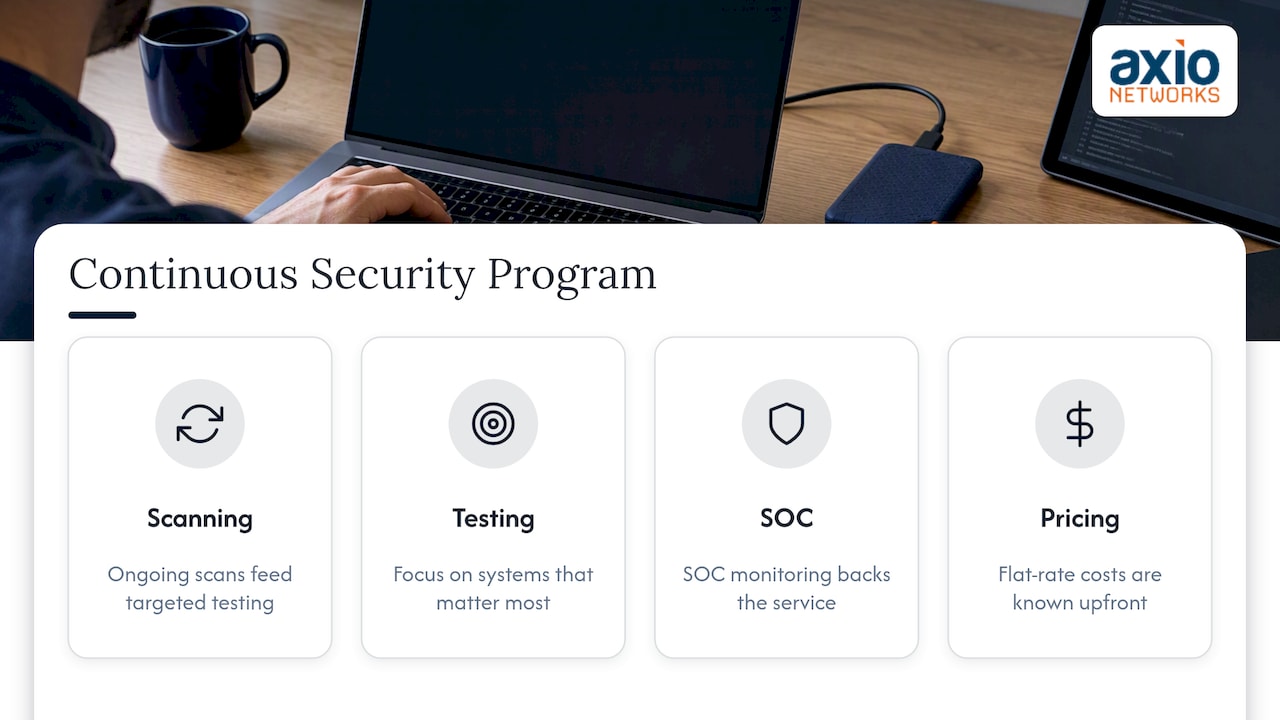
We build our risk and vulnerability management service around this exact pairing: ongoing scanning that feeds into targeted penetration testing on the systems that matter most. Our security-first approach means vulnerability management isn’t a bolt-on, it’s built into every managed service we deliver, backed by SOC monitoring and flat-rate pricing so clients know what the program costs before it starts. That structure maps directly to the checklist above: clear scoping, remediation support, and retesting are part of how we run engagements.
Where Businesses Get This Wrong
The most common mistake we see is treating a penetration test as a once-a-year compliance checkbox with no scanning in between. A test is only as useful as the program around it: scans should inform what gets tested, and every finding needs tracking to closure, not just a report that sits in a folder.
— Jim O’Connell
How We Can Help You Build a Working Program
Small and mid-sized businesses rarely have the staff to run continuous scanning, coordinate penetration tests, and chase remediation on their own, and that’s exactly the gap we fill. Our Cybersecurity Services bundle risk and vulnerability management with monitoring and response under one flat-rate contract, so there’s no surprise invoice when a scan turns up a cluster of findings that need a closer look.
What that looks like in practice:
- Continuous vulnerability scanning across network, endpoint, and cloud assets, with findings triaged by our local team.
- Coordinated penetration testing scheduled around major changes or compliance needs, not left to chance.
- SOC monitoring and rapid response services, designed to address issues promptly.
- Flat-rate pricing structures to help assessment and remediation work fit a predictable monthly budget instead of a surprise project fee.
If you want a straight answer on where your environment stands, reach out through our Managed IT Services page and we’ll walk you through how a combined scanning and testing program would fit your business.
FAQ
What is the difference between vulnerability assessment and penetration testing?
A vulnerability assessment scans systems to find and list known weaknesses, while a penetration test manually attempts to exploit the most serious ones to prove real impact. They answer different questions: a VA shows what might be wrong, and a pen test shows what an attacker could actually do with it.
What is the difference between a penetration test and a security assessment?
A security assessment is a broader term that can include document review, policy checks, and vulnerability scanning, while a penetration test is specifically a hands-on attempt to exploit weaknesses. NIST SP 800-115 treats penetration testing as one technique within a larger assessment process rather than a synonym for it.
What is the main difference between a vulnerability assessment and a penetration test?
The main difference is depth versus breadth: a vulnerability assessment is automated and covers a wide range of systems, while a penetration test is manual and focused on proving exploitability for high-risk targets. One finds possible problems, the other confirms which ones are real.
What are the main types of vulnerability assessments?
The main types cover network, host, application and API, and cloud configuration checks, each aimed at a different layer of the environment. Most organizations combine several types so that infrastructure, software, and cloud settings are all checked on a regular cycle.
Sources
- NIST SP 800-115: Technical Guide to Information Security Testing and Assessment
- PCI SSC: Penetration Testing Guidance v1.1
- Fortinet: Vulnerability scanning compare
- TechTarget: Penetration testing vs vulnerability scanning