A small or midsize business needs SOC 2 when customers, usually larger ones, ask for proof that you protect their data and a security questionnaire no longer satisfies them. SOC 2 is an independent report on your controls, written by a licensed CPA firm. You don’t need it by default, but once it shows up in contracts and procurement reviews, it is hard to win deals without it. This guide covers what the report is, which type to choose, how it compares with ISO 27001, what a readiness assessment does, and how to get ready without wrecking your budget.
TL;DR
- SOC 2 is a voluntary attestation framework from the AICPA. A CPA firm examines your controls and issues a report your customers can review.
- Security is the one criterion always in scope. Availability, processing integrity, confidentiality and privacy are added based on your commitments to customers.
- Type I looks at control design at one point in time. Type II tests whether controls worked over a period, and larger buyers usually prefer it.
- Most of the work is internal: scoping, written policies, technical controls and evidence. A readiness assessment finds gaps before the auditor does.
- Start from a customer or contract trigger, not from fashion. If nobody is asking, a solid security baseline comes first.
Table of Contents
- What SOC 2 is, and what it is not
- Do you actually need SOC 2?
- The five Trust Services Criteria
- Type I vs Type II
- SOC 2 vs ISO 27001
- What the auditor looks at, and what the report contains
- What a readiness assessment does
- How long it takes, and what it costs
- A practical path for a small business
- Our perspective
- Getting the IT side of SOC 2 in place
- FAQ
- Sources
What SOC 2 is, and what it is not
SOC 2 stands for System and Organization Controls 2. It is a voluntary standard developed by the AICPA for reporting on the internal controls that protect data. Nobody certifies you. A CPA firm examines your controls against published criteria and gives its opinion in a report.
That difference matters in practice:
- It is a report, not a badge. Your customer reads the auditor’s opinion, the system description and any exceptions. A clean opinion on a narrow scope says less than a candid report on a broad one.
- It is not a law. No statute makes a typical SMB get SOC 2. The pressure comes from customers, partners and insurers.
- It is not HIPAA or PCI. SOC 2 does not make you HIPAA compliant or PCI compliant. Those have their own rules. If you handle patient data, see our HIPAA compliance checklist for SMBs. If you take card payments, start with our PCI compliance checklist.
SOC 2 is built for service organizations: software companies, managed service providers, billing and payroll processors, data hosts, and any business that stores or processes information for other businesses. If you are a consumer-facing retailer, it rarely applies.
Do you actually need SOC 2?
For most small companies the question is commercial. Ask yourself:
- Are prospects asking for it? If two or three deals stalled or got longer because of security reviews, you have your answer.
- Do your contracts require it? Vendor agreements with larger companies, especially in finance and healthcare, often ask for a report or a plan to get one.
- Do you host or process customer data? The more sensitive and the more central to the customer’s operations, the more scrutiny you will get.
- Is your security baseline in place? If you lack multi-factor authentication, tested backups or an incident response plan, fix those first. An audit will find them, and it is cheaper to fix them before.
If you answered no to the first three, you may be better served by a security program you can describe in a short document, mapped to a free framework. Our 30/90/180 day small business cybersecurity checklist lays out that baseline in order.
The five Trust Services Criteria
The AICPA’s Trust Services Criteria cover five categories: security, availability, processing integrity, confidentiality and privacy. Security is generally required. The others are chosen based on your services, commitments, systems, contracts, laws and risks.
| Criterion | What it asks | Who usually adds it |
|---|---|---|
| Security | Is the system protected against unauthorized access and misuse? | Everyone. It is the baseline. |
| Availability | Is the system up and usable as promised? | Hosting, SaaS and anything with an uptime commitment in the contract |
| Processing integrity | Is processing complete, accurate and authorized? | Payroll, billing, transaction processing |
| Confidentiality | Is confidential information protected through its life cycle? | Businesses handling client trade secrets or contracts |
| Privacy | Is personal information handled according to your notice and commitments? | Businesses collecting personal data directly |
The temptation is to include everything to look thorough. Resist it. Every added criterion adds controls to design, evidence to collect and ways to get an exception. Start with security, add what your contracts promise, and expand later.
Type I vs Type II
A Type I report evaluates whether controls are designed and in place at a specific moment. A Type II report evaluates the same controls and whether they operated over a period of time.
What that means for a small business:
- Type I is a stepping stone. It is faster and cheaper, and it can unblock a deal where the buyer mainly wants to see that a program exists.
- Type II is what larger buyers trust. One industry guide calls Type II the gold standard for scaling businesses, while noting that startups often find Type I sufficient early on.
- Ask the buyer. Before you pay for anything, ask the prospect that triggered the request which type they will accept. The answer often changes the plan.
Many companies do a Type I first, then move straight into the observation window for Type II. Others skip Type I entirely if their buyers insist on Type II.
SOC 2 vs ISO 27001
This is the other comparison readers search for, and the two are not interchangeable.
| SOC 2 | ISO 27001 | |
|---|---|---|
| What you get | An attestation report from a CPA firm | A certificate from an accredited certification body |
| Who issues it | Licensed CPA firm | Accredited registrar |
| Approach | Criteria you map controls to, scoped to your commitments | A full information security management system with required documents |
| Strongest recognition | United States | International, especially Europe and Asia |
| Customer sees | The report itself, usually under NDA | A certificate, often publicly verifiable |
The rule of thumb: if your customers are mostly American, SOC 2 is usually what procurement teams ask for. If you sell into Europe, the Middle East or Asia, ISO 27001 often carries more weight. Plenty of companies end up with both, and the underlying controls overlap heavily, so doing one first reduces the work on the second.
What the auditor looks at, and what the report contains
A SOC 2 report contains the auditor’s opinion, management’s assertion, a description of your system, the applicable criteria with your control activities, and appendices. The tests inside follow your own controls, so what you write down is what you get tested on.
In practice, auditors look for evidence in areas like these:
- Access management: who has access, how it is granted and removed, and whether multi-factor authentication is enforced
- Change management: how updates to systems are approved and tracked
- Endpoint and network protection, patching and vulnerability handling
- Logging and monitoring, and how alerts are reviewed and acted on
- Backups and recovery, including whether restores are tested
- Vendor management and employee onboarding, training and offboarding
- Incident response: a written plan and proof that you rehearse it
When your customer reads the report, the value depends on the scope, the period covered and the auditor’s findings and opinion. Buyers who only check that a report exists miss this, and sophisticated ones read the exceptions closely. Plan on being asked about them.
What a readiness assessment does
A readiness assessment is a pre-audit engagement. It documents your current controls, defines scope, analyzes gaps against the criteria and produces a remediation plan before the formal examination. It is not the audit and it produces no report for customers. It is a dry run that tells you what the real thing will find.
The usual shape, per one CPA firm’s description of the process, is a few days of planning, about a week of walkthroughs with evidence collected alongside, and about a week to write up results. Your own calendar will stretch with how quickly your team can pull evidence.
A useful readiness assessment leaves you with:
- A scope statement: which systems, locations, people and vendors are in
- A list of criteria you will include and why
- A gap list ranked by effort and risk
- Owners and dates for each fix
- A realistic start date for the observation period
Do the groundwork before you pay for one
You will get more from a readiness engagement if you arrive with the basics. Start with an inventory of systems and data, and a risk assessment you can show. Our guide to IT risk assessment steps for small businesses walks through it. Then separate what a scan finds from what a human tester finds; our comparison of vulnerability assessments and penetration tests helps you pick.
Don’t forget the public face of the company. Your website is part of your exposed surface, and customers reviewing you will look at it. This overview of small business website security covers practical steps to fold into your gap list.
How long it takes, and what it costs
Expect months, not weeks. A first-time Type II commonly runs nine to twelve months from start to report, including gap remediation and an observation window. That window is at least three months and usually longer. Type I can be done much faster, because it needs no observation period.
Cost has three parts, and quotes that only mention the first one mislead:
- The audit fee. CPA firms price by scope, number of criteria, report type and the size and complexity of your environment. Get at least two quotes with the same scope written out.
- Tooling and technical controls. Endpoint protection, email security, logging, backup and multi-factor authentication. Many SMBs already own some of these.
- Internal time. Someone has to collect evidence, write policies and answer auditor questions. For a small team, this is often the largest hidden cost.
We don’t publish cost ranges here because they swing widely with scope. Ask for written, scoped quotes from CPA firms, and budget for the tools and the time on top.
A practical path for a small business
- Confirm the trigger. Which customers or contracts need it, and which report type will they accept?
- Set a narrow scope. Start with the system customers actually rely on. Security criterion first.
- Close the baseline gaps. Multi-factor authentication everywhere, patching, endpoint detection, tested backups, email filtering, security training and a written incident plan.
- Write policies people will follow. Auditors test what you say you do. A short policy you follow beats a long template you don’t.
- Run a readiness assessment. Fix the gap list and then pick a start date.
- Collect evidence as you go. Screenshots at the end of the period are weak. Records produced by your systems all year are strong.
- Engage the CPA firm. Choose a firm that works with companies your size and agree on the timeline in writing.
Monitoring matters more than people expect, since auditors want to see alerts being reviewed, not just collected. If you are weighing options, our piece on SOC versus SIEM procurement explains the difference.
Our perspective
The most common mistake we see from small businesses is treating SOC 2 as a paperwork project. Policies get written, a report gets purchased, and then daily operations drift away from what the documents say. The next audit period exposes it, and the customer who asked for the report sees the exceptions.
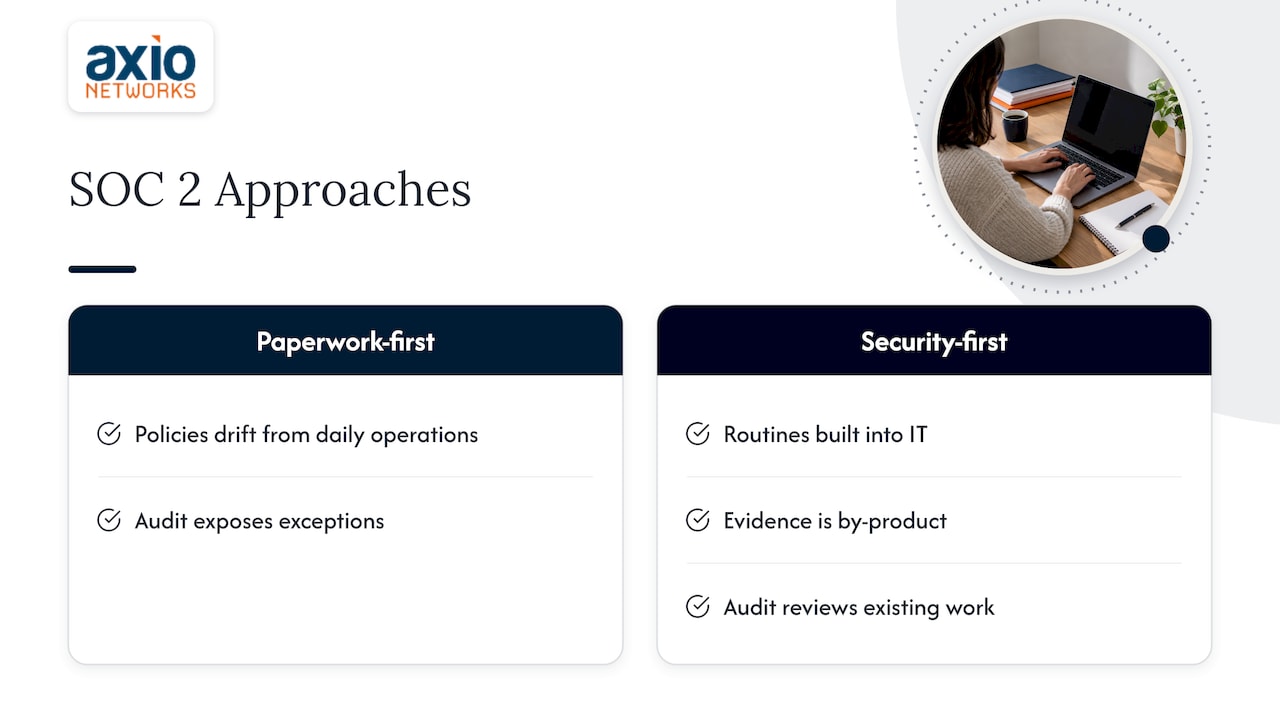
We approach it from the other side. Security has to be built into how IT runs every day: how accounts are created and removed, how devices are patched, how backups are tested, how alerts are handled. When those routines are part of normal operations, evidence is a by-product, and an audit is a review of work already being done. That is what we mean by security-first design.
Our advice to owners is plain. Don’t buy a report to look big. Find the customer need, scope narrowly, fix fundamentals, and let the CPA firm test a program that works. Fixed monthly pricing for the IT behind it helps too, because compliance work is steady and surprise invoices make it hard to stick with.
— Jim O’Connell
Getting the IT side of SOC 2 in place
The audit itself is performed by a CPA firm, and we don’t replace that. What we do is run the day-to-day IT and security that auditors test: managed IT, endpoint protection, email security, SOC monitoring, backup and recovery, and risk and vulnerability assessments for small and midsize businesses across the Phoenix metro area. Our regulatory compliance services page describes how we support SOC-related work, and our cybersecurity services cover the technical controls.
If you want to talk through scope and gaps before you approach an auditor, contact us through our site.
FAQ
Does SOC 2 mean we are HIPAA compliant?
No. SOC 2 is an attestation against the Trust Services Criteria, while HIPAA is a federal law with its own privacy, security and breach notification rules. Some controls overlap, so SOC 2 work can support HIPAA efforts, but one does not stand in for the other. If you handle protected health information, treat HIPAA as a separate program.
Is SOC 2 required by law?
Not for a typical business. It is voluntary, and the AICPA developed it as a reporting framework rather than a regulation. The requirement usually comes from a customer contract or a vendor review.
Can a very small company get a SOC 2 report?
Yes. Small companies do it regularly, usually with a narrow scope and a clear customer driver. The controls are scaled to your size, but you still need documented policies and evidence that they operate.
Should we do Type I or Type II first?
Ask your buyer which they will accept. A Type I can open doors sooner, while Type II is what larger customers usually prefer. If your buyers insist on Type II, going straight to it avoids paying twice.
Do we need a readiness assessment?
It is not mandatory, but for a first audit it is usually worth it. It shows gaps and scope problems while they are cheap to fix. It also gives you a dated plan to follow.
Sources
- What is SOC 2 (System and Organization Controls 2)?, TechTarget
- 2017 Trust Services Criteria (With Revised Points of Focus 2022), AICPA
- How to get SOC 2 compliance, ConnectWise
- SOC 2 vs ISO 27001, Secureframe
- A practical guide to SOC readiness, Deloitte
- What to Expect from a SOC 2 Readiness Assessment, Schellman
- Security Compliance Cheat Sheet: SOC 2, ISO 27001 & More
- Protect Your Small Business Website Security in 2026